
Market Outlook
By 2035, the U.S. Health Data Platforms & Analytics Market is projected to reach USD 61.4 billion, expanding at a CAGR of 16.9% during 2026–2035. The market was valued at USD 14.6 billion in 2025, driven by an exponential surge in healthcare digitization, data interoperability initiatives, and federal data-sharing mandates under the 21st Century Cures Act.
The United States is rapidly transitioning to a data-driven healthcare ecosystem, integrating Electronic Health Records (EHRs), claims data, clinical registries, patient-generated data, and real-world evidence (RWE) through unified health data platforms. These analytics systems are enabling predictive modeling, population health management, clinical decision intelligence, and payer optimization, significantly transforming care delivery, cost containment, and regulatory compliance.
With over 2.5 quintillion bytes of health data generated daily from hospitals, telehealth sessions, wearables, and genomic databases, U.S. health systems are prioritizing secure, interoperable, cloud-native analytics ecosystems that align with HIPAA, CMS interoperability standards, and FHIR (Fast Healthcare Interoperability Resources) frameworks.
Introduction
The U.S. healthcare data ecosystem is undergoing one of the most transformative phases in its history. Amid evolving CMS data-sharing rules, ONC Health IT certifications, and digital-first strategies, health organizations are investing in data integration and analytics platforms to enable real-time, evidence-based decision-making.
From value-based care reimbursement models to precision population analytics, the convergence of AI, big data, cloud infrastructure, and advanced visualization tools has made healthcare analytics indispensable to payers, providers, and life sciences companies alike.
Health data platforms not only consolidate massive datasets but also drive actionable insights across clinical outcomes, operational performance, and financial optimization, making them central to the U.S. healthcare innovation strategy.
Key Market Drivers
- Federal Mandates Driving Interoperability
The U.S. Office of the National Coordinator (ONC) and Centers for Medicare & Medicaid Services (CMS) have implemented regulations mandating interoperability and open APIs, fueling the adoption of FHIR-based data platforms and standardized patient data exchange. These mandates are accelerating the deployment of enterprise analytics ecosystems across hospitals and payer networks. - Shift Toward Value-Based Care
Payers and providers are under mounting pressure to measure and optimize care outcomes. Analytics platforms enable cost-risk stratification, outcome benchmarking, and clinical pathway optimization, helping healthcare organizations achieve shared savings and value-based contracts. - Growing Real-World Evidence (RWE) Applications
Pharmaceutical and biotech companies are increasingly leveraging health data analytics to conduct post-market surveillance, patient cohort identification, and clinical trial simulation using de-identified real-world datasets sourced from claims, EHR, and registry data. - Cloud Adoption and Scalable Infrastructure
The rise of HIPAA-compliant cloud architectures by Microsoft Azure, Google Cloud Healthcare API, and AWS HealthLake has significantly improved data accessibility, scalability, and advanced analytics capabilities across healthcare networks. - Surge in Predictive and Prescriptive Analytics
Hospitals and integrated delivery networks (IDNs) are utilizing machine learning and predictive models to forecast readmissions, detect clinical deterioration, and optimize resource utilization, contributing to better care coordination and cost savings.
Innovation in Focus: How Data Platform Providers Are Raising the Bar
Innovation in the U.S. Health Data Platforms & Analytics Market is focused on interoperability, cloud-native intelligence, and secure real-time analytics. Providers are reimagining how data is collected, connected, and converted into actionable healthcare insights.
- Intelligent Data Fabrics:
Healthcare systems are shifting from data silos to unified data fabrics that link EHRs, claims, imaging, and SDOH data through FHIR-based integration. Platforms like Oracle Health and Snowflake Healthcare Data Cloud lead in enabling seamless, enterprise-wide data exchange. - Real-Time Predictive Analytics:
AI and machine learning models are powering predictive and prescriptive analytics, helping hospitals forecast patient volumes, reduce readmissions, and enhance population health outcomes. Innovaccer and Health Catalyst are among key innovators driving this transformation. - Privacy-First Collaboration:
With rising regulatory scrutiny, leading vendors like Palantir and AWS HealthLake are developing federated and de-identified analytics frameworks to enable secure, multi-institution data collaboration without compromising HIPAA compliance. - Democratized Insights:
Low-code analytics and visualization tools from Tableau (Salesforce) and Microsoft Power BI Healthcare are simplifying access to actionable insights, empowering clinical and administrative teams alike.
Recent Developments
- June 2025: Google Health launched FHIR-native connectors for cross-platform data sharing among EHR systems.
- October 2025: Oracle Health partnered with the Department of Veterans Affairs to modernize federal health data infrastructure.
- December 2025: Innovaccer introduced AI-powered clinical intelligence dashboards for multi-hospital networks in Texas and California.
- February 2026: Microsoft announced Azure Health Data Fabric, integrating genomics and patient engagement data analytics.
Conclusion
The U.S. Health Data Platforms & Analytics Market stands at the intersection of healthcare digitization, cloud transformation, and regulatory evolution. As interoperability mandates expand and healthcare organizations pursue data democratization, the integration of scalable, secure, and intelligent analytics platforms will redefine U.S. healthcare delivery.
The long-term growth trajectory remains supported by policy incentives, AI-driven innovation, and private-public partnerships, making this sector foundational to the next-generation U.S. health economy.
Key Market Players
The U.S. Health Data Platforms & Analytics Market is moderately consolidated, featuring a mix of healthcare EHR leaders, cloud infrastructure providers, and data analytics innovators driving interoperability, AI integration, and population health intelligence. Key players include:
- Epic Systems Corporation (Wisconsin) – Leads U.S. health data integration with Epic Cosmos and population analytics across major hospital networks.
- Oracle Health (formerly Cerner, Missouri) – Expanding cloud-based data intelligence, payer analytics, and large-scale health data modernization projects.
- Microsoft Azure for Healthcare (Washington) – Provides Azure Health Data Services with integrated AI, FHIR, and real-time clinical analytics capabilities.
- Google Cloud Healthcare API (California) – Enables FHIR-based data sharing and large-scale analytics for hospitals, payers, and life sciences firms.
- Amazon Web Services (AWS HealthLake, Washington) – Powers HIPAA-compliant data lakes, AI analytics, and federated interoperability across U.S. health systems.
- Health Catalyst (Utah) – Specializes in enterprise data warehouses and analytics platforms for performance improvement and value-based care.
- Optum (UnitedHealth Group, Minnesota) – Combines payer and provider data to deliver risk analytics, cost optimization, and population health insights.
- Innovaccer (California) – Offers Data Activation Platform unifying clinical, financial, and social health data for actionable analytics.
- Snowflake Healthcare Data Cloud (Montana) – Provides multi-source, cloud-native data interoperability and analytics for providers and payers.
- SAS Institute (North Carolina) – A pioneer in predictive healthcare analytics used for forecasting, risk management, and public health modeling.
- IBM Watson Health (New York) – Delivers AI-driven analytics, clinical decision support, and operational intelligence tools for providers and insurers.
- Tableau (Salesforce, California) – Simplifies healthcare BI and visualization with low-code dashboards for hospitals and public health agencies.
- Palantir Technologies (Colorado) – Supports federal and public health analytics through Palantir Foundry, used by CDC and HHS.
- Arcadia.io (Massachusetts) – Provides population health analytics and value-based care solutions for ACOs and integrated networks.
- Clarify Health (California) – Offers predictive analytics and performance intelligence for payers and large provider groups.
- Flatiron Health (New York) – Specializes in oncology data and real-world evidence analytics for precision medicine and research.
- Trilliant Health (Tennessee) – Focuses on healthcare demand forecasting and market analytics for provider strategy.
- Veradigm (Illinois) – Integrates payer-provider data to deliver analytics for ambulatory care and reimbursement optimization.
- Philips HealthSuite (Massachusetts) – Offers cloud-based health data management and connected patient analytics platforms.
- Athenahealth (Massachusetts) – Provides practice analytics and population health solutions for community healthcare networks.
- IQVIA (Connecticut) – Combines real-world data and clinical analytics for pharmaceutical and payer applications.
- InterSystems (Massachusetts) – Developer of HealthShare, powering state HIEs and large-scale interoperability and analytics ecosystems.
- Software (Dominant Segment):
Comprehensive data management and analytics platforms remain the backbone of healthcare operations. They integrate EHRs, claims, and genomic data, providing a unified data lake that supports clinical and operational analytics. U.S. hospitals increasingly prefer modular platforms with embedded AI and visualization dashboards. - Services (Fastest Growing Segment):
Professional services, including data migration, integration, interoperability consulting, and analytics-as-a-service (AaaS), are expanding rapidly, driven by the complexity of data silos and interoperability compliance. - Hardware:
Used primarily for on-premises data centers, imaging archives, and high-performance computing (HPC) clusters for genomic and population-level analysis.
- Cloud-Based (Dominant & Fastest Growing):
Over 70% of U.S. healthcare organizations are transitioning to cloud-native architectures using platforms like AWS HealthLake, Google Cloud Healthcare Data Engine, and Microsoft Azure Synapse. Cloud enables elastic scalability, real-time analytics, and cross-enterprise data sharing. - On-Premise:
Continues to serve institutions prioritizing data sovereignty, security, and customized governance, particularly Department of Veterans Affairs (VA) systems and large academic health centers.
Segmentation By Application
- Population Health Management (Dominant):
Utilized by payers and Accountable Care Organizations (ACOs) for risk stratification, chronic disease management, and preventive health initiatives. - Clinical Decision Support:
Integrated into EHR workflows to provide real-time patient insights, flag anomalies, and optimize care pathways based on historical and contextual data. - Operational & Financial Analytics:
Helps providers analyze utilization rates, workforce allocation, and revenue cycle optimization, crucial for cost reduction and compliance reporting. - Patient Engagement & Experience Analytics:
Platforms like Epic MyChart and Oracle Health Experience Cloud are enabling personalized engagement through behavioral data and sentiment analysis. - RWE & Clinical Research Analytics:
Used by pharmaceutical companies to identify patient cohorts and model trial outcomes through synthetic control arms.
- Hospitals & Health Systems (Dominant):
Major adopters due to extensive data generation, EHR integration needs, and performance benchmarking requirements. - Payers & Insurance Providers:
Utilize analytics to detect fraud, waste, and abuse (FWA), streamline claims processing, and support value-based reimbursement. - Pharmaceutical & Life Sciences Companies:
Depend on de-identified data platforms for RWE studies, clinical trials, and market access analytics. - Public Health Agencies:
Employ analytics for disease surveillance, epidemiological mapping, and policy modeling, especially through CDC and NIH-led programs.
West Region (Market Leader)
- The West region, led by California, Washington, Oregon, Colorado, and Arizona, dominates due to the concentration of digital health innovation clusters.
- California anchors the market with hubs like Silicon Valley, San Diego, and Los Angeles, hosting leaders such as Google Health, Palantir, and Innovaccer.
- Washington (Seattle) is home to Microsoft Azure Healthcare, while Colorado hosts growing analytics startups focused on hospital interoperability.
- The region’s advanced cloud infrastructure and AI-driven data science ecosystems are fueling partnerships with large health systems including Kaiser Permanente and Sutter Health.
Northeast (High Institutional Adoption)
- States like Massachusetts, New York, Pennsylvania, and New Jersey lead in healthcare research and academic medicine.
- The Boston–Cambridge cluster houses health analytics pioneers such as Health Catalyst, Optum Labs, and Arcadia.io.
- New York’s dense hospital networks (Mount Sinai, NYU Langone) are driving RWE adoption through data sharing initiatives funded by the ONC and NIH All of Us Research Program.
South (Fastest Growing Region)
- Comprising Texas, Florida, Georgia, and North Carolina, the South region’s rapid growth stems from healthcare modernization and telehealth expansion.
- Texas and North Carolina anchor strong data ecosystems, including UNC Health Data Science Institute and Dell Medical Center, fostering public-private collaborations.
- States like Florida and Georgia are embracing AI-driven Medicaid analytics to improve population health and reduce fraud.
Midwest (Steady Growth)
- Driven by states like Illinois, Ohio, Michigan, and Minnesota, the Midwest combines healthcare excellence with strong manufacturing data integration.
- Cleveland Clinic, Mayo Clinic, and Ascension Health are spearheading data interoperability initiatives using AWS and Oracle platforms.
- The Midwest also benefits from federal Medicare modernization pilots and health information exchange (HIE) advancements.
1. U.S. Health Data Platforms & Analytics Market: Market Introduction & Context
1.1 Market Definition
1.2 Scope of the Study
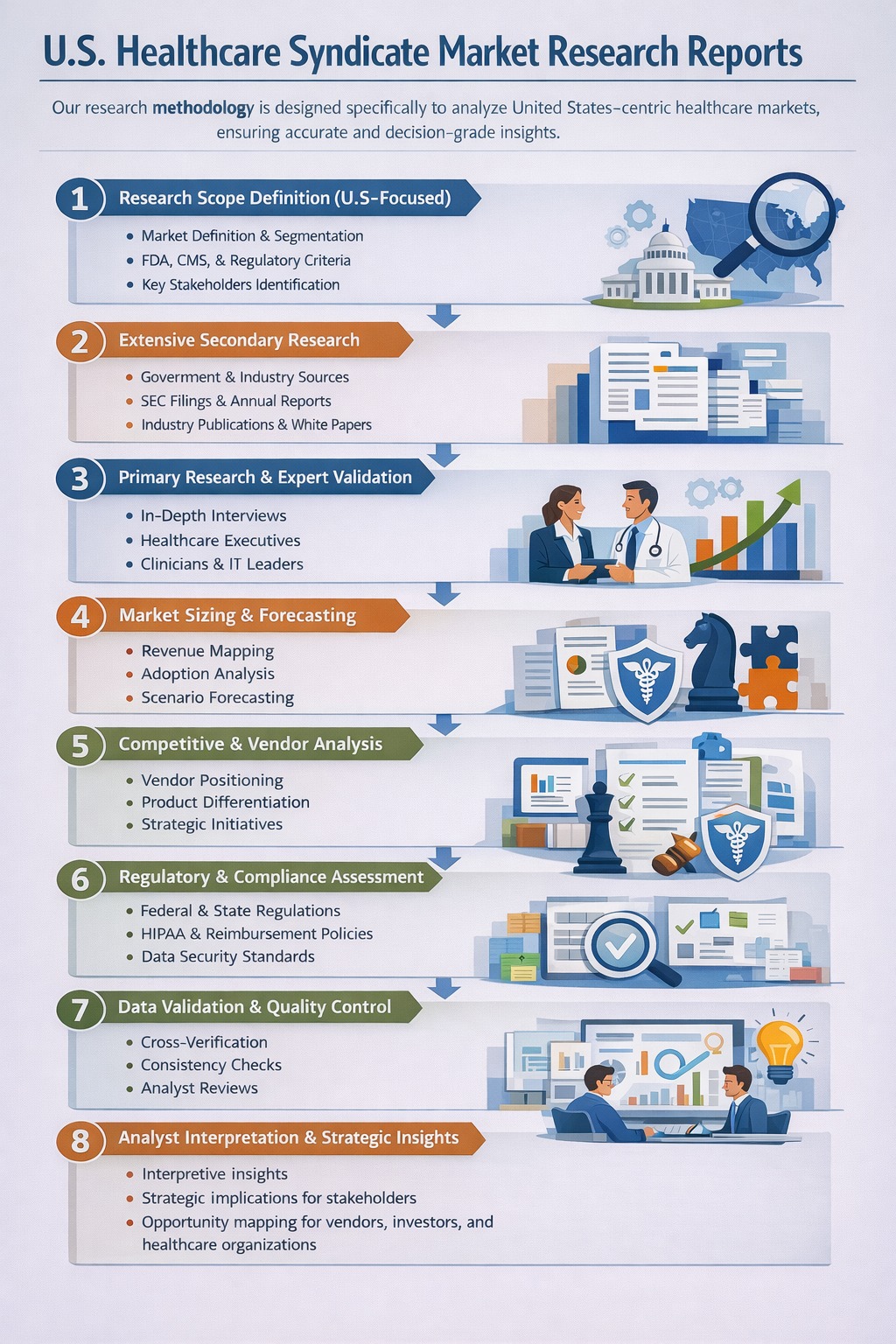
1.3 Research Methodology
1.3.1 Primary Data Collection
1.3.2 Secondary Data Sourcing
1.3.3 External Industry Collaborations
1.3.4 In-House Research Databases
1.4 Analytical Frameworks & Forecasting Models
1.5 Data Validation and Final Report Publishing
1.6 Key Assumptions
1.7 Market Ecosystem Overview
1.8 Stakeholder Analysis (Platform Providers, Cloud Vendors, Analytics Providers, EHR Vendors, Payers, Regulators)
What this section provides:
Introduces report scope, data methodology, and study assumptions. It establishes a transparent foundation for understanding research accuracy, data sources, and the market ecosystem.
2. U.S. Health Data Platforms & Analytics Market: Executive Summary
2.1 Key Market Insights & Takeaways
2.2 Analyst Viewpoint
2.3 Market Attractiveness Index
2.4 Segmental & Regional Snapshot
What this section provides:
Summarizes key findings, analyst perspectives, and market potential, providing a concise snapshot for quick strategic reference.
3. U.S. Health Data Platforms & Analytics Market: Market Dynamics & Outlook
3.1 Market Drivers
3.2 Market Restraints
3.3 Market Opportunities (Data Interoperability, Real-World Evidence, Cloud Scalability)
3.4 Emerging Trends & Patent Landscape (2020–2026)
What this section provides:
Explains key growth drivers, barriers, and innovation trends shaping the U.S. health data and analytics ecosystem.
4. U.S. Health Data Platforms & Analytics Market: Market Environment & Industry Overview
4.1 PESTEL Analysis
4.1.1 Political
4.1.2 Economic
4.1.3 Social
4.1.4 Technological
4.1.5 Environmental
4.1.6 Legal
4.2 Porter’s Five Forces Analysis
4.2.1 Threat of New Entrants
4.2.2 Bargaining Power of Buyers
4.2.3 Bargaining Power of Suppliers
4.2.4 Threat of Substitutes
4.2.5 Competitive Rivalry
4.3 Pricing Trend Analysis (2024–2030)
4.4 Value Chain & Supply Chain Analysis
4.5 Regulatory Framework (HIPAA, TEFCA, FHIR, CMS, ONC, and State-Level Mandates)
4.6 Impact of Digital Transformation
4.7 Government Initiatives & Data Modernization Programs
What this section provides:
Covers the regulatory and competitive landscape, analyzing how political, technological, and economic factors influence U.S. data platform adoption.
5. U.S. Health Data Platforms & Analytics Market – By Component
5.1 Overview
5.2 Segment Share Analysis, By Component, 2025 & 2035 (%)
5.2.1 Software
5.2.2 Hardware
5.2.3 Services
What this section provides:
Analyzes component-level demand, outlining which solutions (software, hardware, or services) drive market growth.
6. U.S. Health Data Platforms & Analytics Market – By Deployment Mode
6.1 Overview
6.2 Segment Share Analysis, By Deployment Mode, 2025 & 2035 (%)
6.2.1 On-Premise
6.2.2 Cloud-Based
What this section provides:
Explores how deployment preferences (on-premise vs. cloud) impact adoption rates, cost models, and scalability across the U.S. healthcare sector.
7. U.S. Health Data Platforms & Analytics Market – By Application
7.1 Overview
7.2 Segment Share Analysis, By Application, 2025 & 2035 (%)
7.2.1 Population Health Management
7.2.2 Clinical Decision Support
7.2.3 Operational & Financial Analytics
7.2.4 RWE & Clinical Research Analytics
7.2.5 Patient Engagement Analytics
What this section provides:
Breaks down the primary applications of data analytics across healthcare, research, and payer ecosystems.
8. U.S. Health Data Platforms & Analytics Market – By End User
8.1 Overview
8.2 Segment Share Analysis, By End User, 2025 & 2035 (%)
8.2.1 Hospitals & Health Systems
8.2.2 Payers & Insurance Providers
8.2.3 Pharmaceutical & Life Sciences Companies
8.2.4 Public Health Agencies
8.2.5 Research & Academic Institutes
What this section provides:
Examines adoption trends across healthcare stakeholders, identifying key end-users investing in advanced analytics platforms.
9. U.S. Health Data Platforms & Analytics Market – By Geography
9.1 Introduction
9.2 Segment Share Analysis, By Geography, 2025 & 2035 (%)
9.3 West Region
Overview & Key Trends
Market Size and Forecast, By State (2025–2035, USD Million)
9.3.1 California
9.3.2 Washington
9.3.3 Colorado
9.3.4 Arizona
9.3.5 Oregon
9.3.6 Others (Utah, Nevada, New Mexico, Idaho, Montana, Wyoming, Alaska, Hawaii)
9.4 Northeast Region
Overview & Key Trends
Market Size and Forecast, By State (2025–2035, USD Million)
9.4.1 New York
9.4.2 Massachusetts
9.4.3 New Jersey
9.4.4 Pennsylvania
9.4.5 Connecticut
9.4.6 Others (Maine, Vermont, New Hampshire, Rhode Island, Delaware)
9.5 South Region
Overview & Key Trends
Market Size and Forecast, By State (2025–2035, USD Million)
9.5.1 Texas
9.5.2 Florida
9.5.3 Georgia
9.5.4 North Carolina
9.5.5 Tennessee
9.5.6 South Carolina
9.5.7 Alabama
9.5.8 Others (Mississippi, Louisiana, Arkansas, Kentucky, Oklahoma, Virginia, Maryland, West Virginia)
9.6 Midwest Region
Overview & Key Trends
Market Size and Forecast, By State (2025–2035, USD Million)
9.6.1 Illinois
9.6.2 Ohio
9.6.3 Michigan
9.6.4 Minnesota
9.6.5 Indiana
9.6.6 Wisconsin
9.6.7 Missouri
9.6.8 Others (Iowa, Kansas, Nebraska, North Dakota, South Dakota)
What this section provides:
Delivers in-depth geographic and state-level analysis — identifying adoption hubs, growth differentials, and emerging healthcare data ecosystems.
10. U.S. Health Data Platforms & Analytics Market – Competitive Landscape & Company Profiles
10.1 Market Share Analysis (2025)
10.2 Company Positioning Matrix (Leaders, Challengers, Innovators)
10.3 Company Profiles (Overview, Offerings, Strategies, Financials, Recent Developments)
Key Players Covered:
10.3.1 Epic Systems Corporation (Wisconsin)
10.3.2 Oracle Health (formerly Cerner, Missouri)
10.3.3 Microsoft Azure for Healthcare (Washington)
10.3.4 Google Cloud Healthcare API (California)
10.3.5 Amazon Web Services (AWS HealthLake, Washington)
10.3.6 Health Catalyst (Utah)
10.3.7 Optum (UnitedHealth Group, Minnesota)
10.3.8 Innovaccer (California)
10.3.9 Snowflake Healthcare Data Cloud (Montana)
10.3.10 SAS Institute (North Carolina)
10.3.11 IBM Watson Health (New York)
10.3.12 Tableau (Salesforce, California)
10.3.13 Palantir Technologies (Colorado)
10.3.14 Arcadia.io (Massachusetts)
10.3.15 Clarify Health (California)
10.3.16 Flatiron Health (New York)
10.3.17 Trilliant Health (Tennessee)
10.3.18 Veradigm (Illinois)
10.3.19 Philips HealthSuite (Massachusetts)
10.3.20 Athenahealth (Massachusetts)
10.3.21 IQVIA (Connecticut)
10.3.22 InterSystems (Massachusetts)
What this section provides:
Profiles leading U.S. vendors in health data and analytics, detailing strategic initiatives, partnerships, innovations, and market positioning.
11. U.S. Health Data Platforms & Analytics Market – Future Market Outlook (2025–2035)
11.1 Scenario Analysis (Optimistic, Realistic, Pessimistic)
11.2 Disruptive Technologies (AI, Edge Analytics, Federated Models)
11.3 Emerging Business Models & Start-up Ecosystem
11.4 Strategic Roadmap for Stakeholders
What this section provides:
Forecasts market evolution under multiple growth scenarios, addressing technology disruption and evolving business models.
12. U.S. Health Data Platforms & Analytics Market – Strategic Recommendations
12.1 Recommendations for Data Platform Vendors
12.2 Recommendations for Providers and Payers
12.3 Regulatory and Compliance Guidance
12.4 Investment Opportunities & Risk Mitigation
What this section provides:
Offers actionable guidance for platform vendors, payers, and regulators to optimize investments and navigate market challenges.
13. U.S. Health Data Platforms & Analytics Market – Disclaimer
Explains data sources, report usage terms, and research limitations.
What this section provides:
Ensures transparency by outlining assumptions, boundaries, and disclaimers relevant to data interpretation and report use.
LIST OF TABLES
TABLE 1: List of Data Sources
TABLE 2: Market Drivers; Impact Analysis
TABLE 3: Market Restraints; Impact Analysis
TABLE 4: U.S. Health Data Platforms & Analytics Market: Component Snapshot (2025)
TABLE 5: Segment Dashboard; Definition and Scope, by Component
TABLE 6: U.S. Health Data Platforms & Analytics Market, by Component, 2022–2035 (USD Million)
TABLE 7: U.S. Health Data Platforms & Analytics Market: Deployment Mode Snapshot (2025)
TABLE 8: Segment Dashboard; Definition and Scope, by Deployment Mode
TABLE 9: U.S. Health Data Platforms & Analytics Market, by Deployment Mode, 2022–2035 (USD Million)
TABLE 10: U.S. Health Data Platforms & Analytics Market: Application Snapshot (2025)
TABLE 11: Segment Dashboard; Definition and Scope, by Application
TABLE 12: U.S. Health Data Platforms & Analytics Market, by Application, 2022–2035 (USD Million)
TABLE 13: U.S. Health Data Platforms & Analytics Market: End-User Snapshot (2025)
TABLE 14: Segment Dashboard; Definition and Scope, by End-User
TABLE 15: U.S. Health Data Platforms & Analytics Market, by End-User, 2022–2035 (USD Million)
TABLE 16: U.S. Health Data Platforms & Analytics Market: Regional Snapshot (2025)
TABLE 17: Segment Dashboard; Definition and Scope, by Region
TABLE 18: U.S. Health Data Platforms & Analytics Market, by Region, 2022–2035 (USD Million)
West Region
TABLE 19: California Health Data Platforms & Analytics Market, by Component, 2022–2035 (USD Million)
TABLE 20: California Health Data Platforms & Analytics Market, by Deployment Mode, 2022–2035 (USD Million)
TABLE 21: California Health Data Platforms & Analytics Market, by Application, 2022–2035 (USD Million)
TABLE 22: California Health Data Platforms & Analytics Market, by End-User, 2022–2035 (USD Million)
TABLE 23: Washington Health Data Platforms & Analytics Market, by Component, 2022–2035 (USD Million)
TABLE 24: Washington Health Data Platforms & Analytics Market, by Deployment Mode, 2022–2035 (USD Million)
TABLE 25: Washington Health Data Platforms & Analytics Market, by Application, 2022–2035 (USD Million)
TABLE 26: Washington Health Data Platforms & Analytics Market, by End-User, 2022–2035 (USD Million)
TABLE 27: Colorado Health Data Platforms & Analytics Market, by Component, 2022–2035 (USD Million)
TABLE 28: Colorado Health Data Platforms & Analytics Market, by Deployment Mode, 2022–2035 (USD Million)
TABLE 29: Colorado Health Data Platforms & Analytics Market, by Application, 2022–2035 (USD Million)
TABLE 30: Colorado Health Data Platforms & Analytics Market, by End-User, 2022–2035 (USD Million)
TABLE 31: Arizona Health Data Platforms & Analytics Market, by Component, 2022–2035 (USD Million)
TABLE 32: Arizona Health Data Platforms & Analytics Market, by Deployment Mode, 2022–2035 (USD Million)
TABLE 33: Arizona Health Data Platforms & Analytics Market, by Application, 2022–2035 (USD Million)
TABLE 34: Arizona Health Data Platforms & Analytics Market, by End-User, 2022–2035 (USD Million)
TABLE 35: Oregon Health Data Platforms & Analytics Market, by Component, 2022–2035 (USD Million)
TABLE 36: Oregon Health Data Platforms & Analytics Market, by Deployment Mode, 2022–2035 (USD Million)
TABLE 37: Oregon Health Data Platforms & Analytics Market, by Application, 2022–2035 (USD Million)
TABLE 38: Oregon Health Data Platforms & Analytics Market, by End-User, 2022–2035 (USD Million)
TABLE 39: West – Others Health Data Platforms & Analytics Market, by Component, 2022–2035 (USD Million)
TABLE 40: West – Others Health Data Platforms & Analytics Market, by Deployment Mode, 2022–2035 (USD Million)
TABLE 41: West – Others Health Data Platforms & Analytics Market, by Application, 2022–2035 (USD Million)
TABLE 42: West – Others Health Data Platforms & Analytics Market, by End-User, 2022–2035 (USD Million)
(Utah, Nevada, New Mexico, Idaho, Montana, Wyoming, Alaska, Hawaii)
Northeast Region
TABLE 43: New York Health Data Platforms & Analytics Market, by Component, 2022–2035 (USD Million)
TABLE 44: New York Health Data Platforms & Analytics Market, by Deployment Mode, 2022–2035 (USD Million)
TABLE 45: New York Health Data Platforms & Analytics Market, by Application, 2022–2035 (USD Million)
TABLE 46: New York Health Data Platforms & Analytics Market, by End-User, 2022–2035 (USD Million)
TABLE 47: Massachusetts Health Data Platforms & Analytics Market, by Component, 2022–2035 (USD Million)
TABLE 48: Massachusetts Health Data Platforms & Analytics Market, by Deployment Mode, 2022–2035 (USD Million)
TABLE 49: Massachusetts Health Data Platforms & Analytics Market, by Application, 2022–2035 (USD Million)
TABLE 50: Massachusetts Health Data Platforms & Analytics Market, by End-User, 2022–2035 (USD Million)
TABLE 51: New Jersey Health Data Platforms & Analytics Market, by Component, 2022–2035 (USD Million)
TABLE 52: New Jersey Health Data Platforms & Analytics Market, by Deployment Mode, 2022–2035 (USD Million)
TABLE 53: New Jersey Health Data Platforms & Analytics Market, by Application, 2022–2035 (USD Million)
TABLE 54: New Jersey Health Data Platforms & Analytics Market, by End-User, 2022–2035 (USD Million)
TABLE 55: Pennsylvania Health Data Platforms & Analytics Market, by Component, 2022–2035 (USD Million)
TABLE 56: Pennsylvania Health Data Platforms & Analytics Market, by Deployment Mode, 2022–2035 (USD Million)
TABLE 57: Pennsylvania Health Data Platforms & Analytics Market, by Application, 2022–2035 (USD Million)
TABLE 58: Pennsylvania Health Data Platforms & Analytics Market, by End-User, 2022–2035 (USD Million)
TABLE 59: Connecticut Health Data Platforms & Analytics Market, by Component, 2022–2035 (USD Million)
TABLE 60: Connecticut Health Data Platforms & Analytics Market, by Deployment Mode, 2022–2035 (USD Million)
TABLE 61: Connecticut Health Data Platforms & Analytics Market, by Application, 2022–2035 (USD Million)
TABLE 62: Connecticut Health Data Platforms & Analytics Market, by End-User, 2022–2035 (USD Million)
TABLE 63: Northeast – Others Health Data Platforms & Analytics Market, by Component, 2022–2035 (USD Million)
TABLE 64: Northeast – Others Health Data Platforms & Analytics Market, by Deployment Mode, 2022–2035 (USD Million)
TABLE 65: Northeast – Others Health Data Platforms & Analytics Market, by Application, 2022–2035 (USD Million)
TABLE 66: Northeast – Others Health Data Platforms & Analytics Market, by End-User, 2022–2035 (USD Million)
(Maine, Vermont, New Hampshire, Rhode Island, Delaware)
South Region
TABLE 67: Texas Health Data Platforms & Analytics Market, by Component, 2022–2035 (USD Million)
TABLE 68: Texas Health Data Platforms & Analytics Market, by Deployment Mode, 2022–2035 (USD Million)
TABLE 69: Texas Health Data Platforms & Analytics Market, by Application, 2022–2035 (USD Million)
TABLE 70: Texas Health Data Platforms & Analytics Market, by End-User, 2022–2035 (USD Million)
TABLE 71: Florida Health Data Platforms & Analytics Market, by Component, 2022–2035 (USD Million)
TABLE 72: Florida Health Data Platforms & Analytics Market, by Deployment Mode, 2022–2035 (USD Million)
TABLE 73: Florida Health Data Platforms & Analytics Market, by Application, 2022–2035 (USD Million)
TABLE 74: Florida Health Data Platforms & Analytics Market, by End-User, 2022–2035 (USD Million)
TABLE 75: Georgia Health Data Platforms & Analytics Market, by Component, 2022–2035 (USD Million)
TABLE 76: Georgia Health Data Platforms & Analytics Market, by Deployment Mode, 2022–2035 (USD Million)
TABLE 77: Georgia Health Data Platforms & Analytics Market, by Application, 2022–2035 (USD Million)
TABLE 78: Georgia Health Data Platforms & Analytics Market, by End-User, 2022–2035 (USD Million)
TABLE 79: North Carolina Health Data Platforms & Analytics Market, by Component, 2022–2035 (USD Million)
TABLE 80: North Carolina Health Data Platforms & Analytics Market, by Deployment Mode, 2022–2035 (USD Million)
TABLE 81: North Carolina Health Data Platforms & Analytics Market, by Application, 2022–2035 (USD Million)
TABLE 82: North Carolina Health Data Platforms & Analytics Market, by End-User, 2022–2035 (USD Million)
TABLE 83: Tennessee Health Data Platforms & Analytics Market, by Component, 2022–2035 (USD Million)
TABLE 84: Tennessee Health Data Platforms & Analytics Market, by Deployment Mode, 2022–2035 (USD Million)
TABLE 85: Tennessee Health Data Platforms & Analytics Market, by Application, 2022–2035 (USD Million)
TABLE 86: Tennessee Health Data Platforms & Analytics Market, by End-User, 2022–2035 (USD Million)
TABLE 87: South Carolina Health Data Platforms & Analytics Market, by Component, 2022–2035 (USD Million)
TABLE 88: South Carolina Health Data Platforms & Analytics Market, by Deployment Mode, 2022–2035 (USD Million)
TABLE 89: South Carolina Health Data Platforms & Analytics Market, by Application, 2022–2035 (USD Million)
TABLE 90: South Carolina Health Data Platforms & Analytics Market, by End-User, 2022–2035 (USD Million)
TABLE 91: Alabama Health Data Platforms & Analytics Market, by Component, 2022–2035 (USD Million)
TABLE 92: Alabama Health Data Platforms & Analytics Market, by Deployment Mode, 2022–2035 (USD Million)
TABLE 93: Alabama Health Data Platforms & Analytics Market, by Application, 2022–2035 (USD Million)
TABLE 94: Alabama Health Data Platforms & Analytics Market, by End-User, 2022–2035 (USD Million)
TABLE 95: South – Others Health Data Platforms & Analytics Market, by Component, 2022–2035 (USD Million)
TABLE 96: South – Others Health Data Platforms & Analytics Market, by Deployment Mode, 2022–2035 (USD Million)
TABLE 97: South – Others Health Data Platforms & Analytics Market, by Application, 2022–2035 (USD Million)
TABLE 98: South – Others Health Data Platforms & Analytics Market, by End-User, 2022–2035 (USD Million)
(Mississippi, Louisiana, Arkansas, Kentucky, Oklahoma, Virginia, Maryland, West Virginia)
Midwest Region
TABLE 99: Illinois Health Data Platforms & Analytics Market, by Component, 2022–2035 (USD Million)
TABLE 100: Illinois Health Data Platforms & Analytics Market, by Deployment Mode, 2022–2035 (USD Million)
TABLE 101: Illinois Health Data Platforms & Analytics Market, by Application, 2022–2035 (USD Million)
TABLE 102: Illinois Health Data Platforms & Analytics Market, by End-User, 2022–2035 (USD Million)
TABLE 103: Ohio Health Data Platforms & Analytics Market, by Component, 2022–2035 (USD Million)
TABLE 104: Ohio Health Data Platforms & Analytics Market, by Deployment Mode, 2022–2035 (USD Million)
TABLE 105: Ohio Health Data Platforms & Analytics Market, by Application, 2022–2035 (USD Million)
TABLE 106: Ohio Health Data Platforms & Analytics Market, by End-User, 2022–2035 (USD Million)
TABLE 107: Michigan Health Data Platforms & Analytics Market, by Component, 2022–2035 (USD Million)
TABLE 108: Michigan Health Data Platforms & Analytics Market, by Deployment Mode, 2022–2035 (USD Million)
TABLE 109: Michigan Health Data Platforms & Analytics Market, by Application, 2022–2035 (USD Million)
TABLE 110: Michigan Health Data Platforms & Analytics Market, by End-User, 2022–2035 (USD Million)
TABLE 111: Minnesota Health Data Platforms & Analytics Market, by Component, 2022–2035 (USD Million)
TABLE 112: Minnesota Health Data Platforms & Analytics Market, by Deployment Mode, 2022–2035 (USD Million)
TABLE 113: Minnesota Health Data Platforms & Analytics Market, by Application, 2022–2035 (USD Million)
TABLE 114: Minnesota Health Data Platforms & Analytics Market, by End-User, 2022–2035 (USD Million)
TABLE 115: Indiana Health Data Platforms & Analytics Market, by Component, 2022–2035 (USD Million)
TABLE 116: Indiana Health Data Platforms & Analytics Market, by Deployment Mode, 2022–2035 (USD Million)
TABLE 117: Indiana Health Data Platforms & Analytics Market, by Application, 2022–2035 (USD Million)
TABLE 118: Indiana Health Data Platforms & Analytics Market, by End-User, 2022–2035 (USD Million)
TABLE 119: Wisconsin Health Data Platforms & Analytics Market, by Component, 2022–2035 (USD Million)
TABLE 120: Wisconsin Health Data Platforms & Analytics Market, by Deployment Mode, 2022–2035 (USD Million)
TABLE 121: Wisconsin Health Data Platforms & Analytics Market, by Application, 2022–2035 (USD Million)
TABLE 122: Wisconsin Health Data Platforms & Analytics Market, by End-User, 2022–2035 (USD Million)
TABLE 123: Missouri Health Data Platforms & Analytics Market, by Component, 2022–2035 (USD Million)
TABLE 124: Missouri Health Data Platforms & Analytics Market, by Deployment Mode, 2022–2035 (USD Million)
TABLE 125: Missouri Health Data Platforms & Analytics Market, by Application, 2022–2035 (USD Million)
TABLE 126: Missouri Health Data Platforms & Analytics Market, by End-User, 2022–2035 (USD Million)
TABLE 127: Midwest – Others Health Data Platforms & Analytics Market, by Component, 2022–2035 (USD Million)
TABLE 128: Midwest – Others Health Data Platforms & Analytics Market, by Deployment Mode, 2022–2035 (USD Million)
TABLE 129: Midwest – Others Health Data Platforms & Analytics Market, by Application, 2022–2035 (USD Million)
TABLE 130: Midwest – Others Health Data Platforms & Analytics Market, by End-User, 2022–2035 (USD Million)
(Iowa, Kansas, Nebraska, North Dakota, South Dakota)
LIST OF FIGURES
FIGURE 1: U.S. Health Data Platforms & Analytics Market Segmentation
FIGURE 2: Market Research Methodology
FIGURE 3: Value Chain Analysis
FIGURE 4: PESTEL Analysis
FIGURE 5: Porter’s Five Forces Analysis
FIGURE 6: Market Attractiveness Analysis
FIGURE 7: Market Dynamics
FIGURE 8: Innovation & Patent Landscape (2020–2026)
FIGURE 9: Competitive Landscape; Key Company Market Share Analysis, 2024
FIGURE 10: Component Segment Market Share Analysis, 2025 & 2035
FIGURE 11: Component Segment Market Size Forecast and Trend Analysis, 2025–2035 (USD Million)
FIGURE 12: Deployment Segment Market Share Analysis, 2025 & 2035
FIGURE 13: Deployment Segment Market Size Forecast and Trend Analysis, 2025–2035 (USD Million)
FIGURE 14: Application Segment Market Share Analysis, 2025 & 2035
FIGURE 15: Application Segment Market Size Forecast and Trend Analysis, 2025–2035 (USD Million)
FIGURE 16: End-User Segment Market Share Analysis, 2025 & 2035
FIGURE 17: End-User Segment Market Size Forecast and Trend Analysis, 2025–2035 (USD Million)
FIGURE 18: Regional Segment Market Share Analysis, 2025 & 2035
FIGURE 19: Regional Segment Market Size Forecast and Trend Analysis, 2025–2035 (USD Million)
Regional Figures
FIGURE 20: West Region U.S. Health Data Platforms & Analytics Market Share and Leading Players, 2024
FIGURE 21: Northeast Region U.S. Health Data Platforms & Analytics Market Share and Leading Players, 2024
FIGURE 22: South Region U.S. Health Data Platforms & Analytics Market Share and Leading Players, 2024
FIGURE 23: Midwest Region U.S. Health Data Platforms & Analytics Market Share and Leading Players, 2024
State-Level Figures
FIGURE 24: California Market Size, Forecast and Trend Analysis, 2025–2035 (USD Million)
FIGURE 25: Washington Market Size, Forecast and Trend Analysis, 2025–2035 (USD Million)
FIGURE 26: Colorado Market Size, Forecast and Trend Analysis, 2025–2035 (USD Million)
FIGURE 27: Arizona Market Size, Forecast and Trend Analysis, 2025–2035 (USD Million)
FIGURE 28: Oregon Market Size, Forecast and Trend Analysis, 2025–2035 (USD Million)
FIGURE 29: Texas Market Size, Forecast and Trend Analysis, 2025–2035 (USD Million)
FIGURE 30: Florida Market Size, Forecast and Trend Analysis, 2025–2035 (USD Million)
FIGURE 31: Georgia Market Size, Forecast and Trend Analysis, 2025–2035 (USD Million)
FIGURE 32: North Carolina Market Size, Forecast and Trend Analysis, 2025–2035 (USD Million)
FIGURE 33: Tennessee Market Size, Forecast and Trend Analysis, 2025–2035 (USD Million)
FIGURE 34: Illinois Market Size, Forecast and Trend Analysis, 2025–2035 (USD Million)
FIGURE 35: Ohio Market Size, Forecast and Trend Analysis, 2025–2035 (USD Million)
FIGURE 36: Michigan Market Size, Forecast and Trend Analysis, 2025–2035 (USD Million)
FIGURE 37: Minnesota Market Size, Forecast and Trend Analysis, 2025–2035 (USD Million)
FIGURE 38: New York Market Size, Forecast and Trend Analysis, 2025–2035 (USD Million)
FIGURE 39: Massachusetts Market Size, Forecast and Trend Analysis, 2025–2035 (USD Million)
FIGURE 40: Pennsylvania Market Size, Forecast and Trend Analysis, 2025–2035 (USD Million)
FIGURE 41: Missouri Market Size, Forecast and Trend Analysis, 2025–2035 (USD Million)
FIGURE 42: Regional Comparative Insights, 2025–2035