
Market Outlook
The U.S. Healthcare Managed Detection and Response (MDR) Services Market was valued at USD 1.92 billion in 2025, with historical analysis from 2021 to 2024. The market is projected to reach approximately USD 8.74 billion by 2035, expanding at a CAGR of 16.38% during the forecast period 2026–2035.
The U.S. healthcare sector continues to experience heightened cybersecurity threats, particularly ransomware, phishing, insider misuse, and advanced persistent threats targeting protected health information (PHI). Healthcare remains one of the most attacked industries due to the high resale value of medical data, time-sensitive operations, and reliance on legacy systems.
With over 6,000 hospitals, expanding telehealth ecosystems, hybrid cloud environments, and widespread deployment of connected medical devices, the healthcare attack surface is rapidly expanding. As a result, Managed Detection and Response (MDR) services are becoming integral to cybersecurity resilience strategies across providers, payers, life sciences firms, and digital health organizations.
MDR services deliver continuous 24/7 monitoring, behavioral analytics, AI-powered detection, threat intelligence integration, proactive threat hunting, and incident containment tailored specifically for healthcare IT infrastructures.
Introduction
The U.S. Healthcare Managed Detection and Response (MDR) Services Market is shaped by digital transformation across clinical systems, stricter regulatory enforcement, cyber insurance mandates, and persistent ransomware campaigns targeting hospitals and research institutions.
Healthcare IT environments today integrate electronic health record (EHR) platforms, medical imaging archives, connected diagnostic devices, remote patient monitoring systems, telehealth portals, and cloud-based billing applications. These interconnected systems create complex cybersecurity challenges that traditional security tools cannot address alone.
MDR services enhance healthcare cybersecurity posture by:
• Monitoring clinical and administrative endpoints in real time
• Detecting abnormal EHR access and credential misuse
• Identifying ransomware behavior patterns
• Securing hybrid cloud infrastructures
• Protecting medical device networks
• Supporting HIPAA, HITECH, and state-level compliance
As cybersecurity becomes a board-level priority, MDR is transitioning from an outsourced IT service to a core operational security framework.
Key Market Drivers
- Escalating Ransomware Incidents
Ransomware remains the dominant cybersecurity threat to U.S. healthcare. Attackers target hospitals during peak operational hours, exploiting vulnerabilities to maximize disruption. MDR services significantly reduce threat dwell time by detecting lateral movement, suspicious encryption activity, and credential compromise in early stages. - Cloud & Hybrid IT Expansion
Healthcare organizations are rapidly migrating EHR systems, imaging storage, claims management, and telehealth platforms to cloud environments. Hybrid infrastructures require unified visibility across on-premise and cloud assets, increasing reliance on cloud-native MDR services. - Regulatory & Insurance Pressures
Federal agencies such as HHS and CISA are strengthening cybersecurity expectations for healthcare entities. Additionally, cyber insurers increasingly require continuous monitoring and incident response capabilities, accelerating MDR adoption. - Connected Medical Devices & IoT Growth
Modern hospitals operate thousands of connected devices, many running outdated firmware. MDR services provide network-level monitoring and anomaly detection to mitigate IoT-related vulnerabilities.
Recent Developments
Healthcare providers are integrating MDR with zero-trust frameworks and AI-based behavioral analytics. Federal initiatives supporting rural hospital cybersecurity resilience are accelerating adoption. Cloud-native MDR platforms are expanding to secure telehealth services, SaaS healthcare tools, and hybrid clinical environments.
Conclusion
The U.S. Healthcare Managed Detection and Response (MDR) Services Market is positioned for sustained double-digit growth through 2035. Rising ransomware attacks, expanding hybrid cloud infrastructures, regulatory enforcement, and connected medical device proliferation are driving strong demand for continuous threat monitoring and rapid response capabilities.
MDR services are evolving into a foundational cybersecurity pillar for U.S. healthcare organizations. As digital transformation accelerates nationwide, MDR will play a critical role in safeguarding patient data, ensuring regulatory compliance, and maintaining uninterrupted healthcare delivery across all regions of the United States.
Key Market Players
The U.S. Healthcare MDR Services Market is moderately consolidated, with global cybersecurity firms and specialized healthcare-focused vendors competing on AI-driven analytics, healthcare compliance expertise, and response speed.
- CrowdStrike – AI-powered endpoint security widely adopted in U.S. hospitals.
- Palo Alto Networks – Advanced network and cloud security solutions for healthcare providers.
- Microsoft Security – Integrated MDR services embedded within Microsoft healthcare IT ecosystems.
- IBM Security – Compliance-focused cybersecurity services tailored to HIPAA-regulated environments.
- Cisco Secure – Secures hospital network infrastructure and connected systems.
- SentinelOne – Autonomous endpoint protection expanding in mid-sized healthcare facilities.
- Rapid7 – Vulnerability management and MDR for hospital networks.
- Arctic Wolf – Outsourced MDR provider for regional and community hospitals.
- Secureworks – Incident response and managed security services for large healthcare systems.
- Sophos – Ransomware-focused MDR protection in healthcare environments.
- Trend Micro – Cloud workload protection for healthcare cloud migrations.
- Fortinet – Network and IoT security solutions for hospital infrastructure.
- Optiv – Advisory-led MDR services with healthcare compliance expertise.
- GuidePoint Security – Healthcare-focused cybersecurity consulting and MDR implementation.
- Trellix – Threat intelligence and advanced detection for enterprise healthcare networks.
- eSentire – SOC-as-a-service provider serving U.S. healthcare clients.
- BlackBerry Cybersecurity – Endpoint and embedded device protection solutions.
- Cybereason – Ransomware detection and threat hunting services.
- Trustwave – Compliance-aligned MDR frameworks for healthcare organizations.
- Secureworks – Expanding healthcare-focused managed security operations.
- Endpoint Detection & Response (EDR) – Dominant
EDR holds the largest share due to the high number of endpoints across hospitals and clinics. MDR-enabled EDR platforms monitor device behavior, block malicious processes, and isolate compromised endpoints in real time. - Network Detection & Response (NDR)
NDR solutions are critical for large hospital systems operating multiple campuses. They analyze network traffic patterns to detect internal threat propagation and command-and-control communications. - Cloud Security & Workload Protection – Fastest Growing
As healthcare cloud adoption expands, MDR providers offer SaaS monitoring, API protection, container security, and cloud workload analytics. - Identity Threat Detection & Response (ITDR)
ITDR addresses credential theft and privilege escalation risks within EHR and administrative systems.
- Cloud-Based MDR – Dominant & Fastest Growing
Cloud-based MDR enables centralized monitoring across distributed healthcare facilities and supports remote workforce security. Scalability and cost efficiency drive adoption. - On-Premise MDR
Certain academic medical centers and research institutions handling sensitive genomic and clinical trial data prefer localized security monitoring. - Hybrid Deployment
Large integrated delivery networks combine on-site telemetry with cloud analytics to maintain flexibility and compliance.
- Hospitals & Integrated Delivery Networks (IDNs) – Dominant
Hospitals represent the largest demand segment due to 24/7 operations, complex IT environments, and high patient data volumes. - Health Insurance Providers
Payers deploy MDR to secure claims systems, financial transactions, and member databases. - Pharmaceutical & Biotechnology Companies
Biopharma organizations utilize MDR to protect intellectual property and R&D pipelines from espionage-driven cyber threats. - Diagnostic & Imaging Centers
Radiology centers require advanced monitoring to protect PACS systems frequently targeted by ransomware. - Telehealth & Digital Health Providers – Fastest Growing
The rapid expansion of API-driven telehealth platforms and remote patient monitoring systems increases cloud-related cybersecurity risks.
- Ransomware – Dominant
Ransomware causes operational shutdowns and financial losses, making proactive detection essential. - Phishing & Social Engineering
Credential theft through email-based attacks remains a leading entry vector. - Insider Threats
Compromised or malicious insiders can expose sensitive PHI and financial data. - Advanced Persistent Threats (APTs)
Research institutions and biotech firms face targeted espionage campaigns. - IoT & Medical Device Exploits
Connected devices present vulnerabilities requiring network-level anomaly monitoring.
West – Market Leader
The West dominates due to advanced digital health ecosystems and cybersecurity innovation hubs. California leads in healthcare IT and cybersecurity investment, supported by large hospital systems and technology partnerships. Washington and Colorado also exhibit strong MDR adoption due to biotech research clusters and integrated health networks. Arizona and Oregon are modernizing healthcare IT infrastructure, further driving MDR demand.
Northeast – High Compliance & Research Activity
The Northeast shows strong MDR adoption driven by dense hospital networks and academic research institutions. New York and Massachusetts host leading medical centers managing large volumes of sensitive research and patient data. Connecticut and New Jersey, home to major insurance and pharmaceutical firms, contribute significantly to regional demand.
South – Fastest Growing Region
Texas leads the South in healthcare infrastructure and cybersecurity spending. Florida’s exposure to ransomware incidents has accelerated MDR adoption. Georgia, North Carolina, Tennessee, and Virginia are expanding hospital systems and digital health initiatives, increasing reliance on outsourced security services.
Midwest – Steady Growth
Illinois, Ohio, Michigan, and Minnesota represent key Midwest markets with established healthcare networks investing in cybersecurity modernization. Rural healthcare facilities across Iowa, Nebraska, Kansas, and the Dakotas increasingly adopt MDR services due to limited in-house security resources.
1. U.S. Healthcare Managed Detection and Response (MDR) Services Market: Market Introduction & Context
1.1 Market Definition
1.2 Scope of the Study
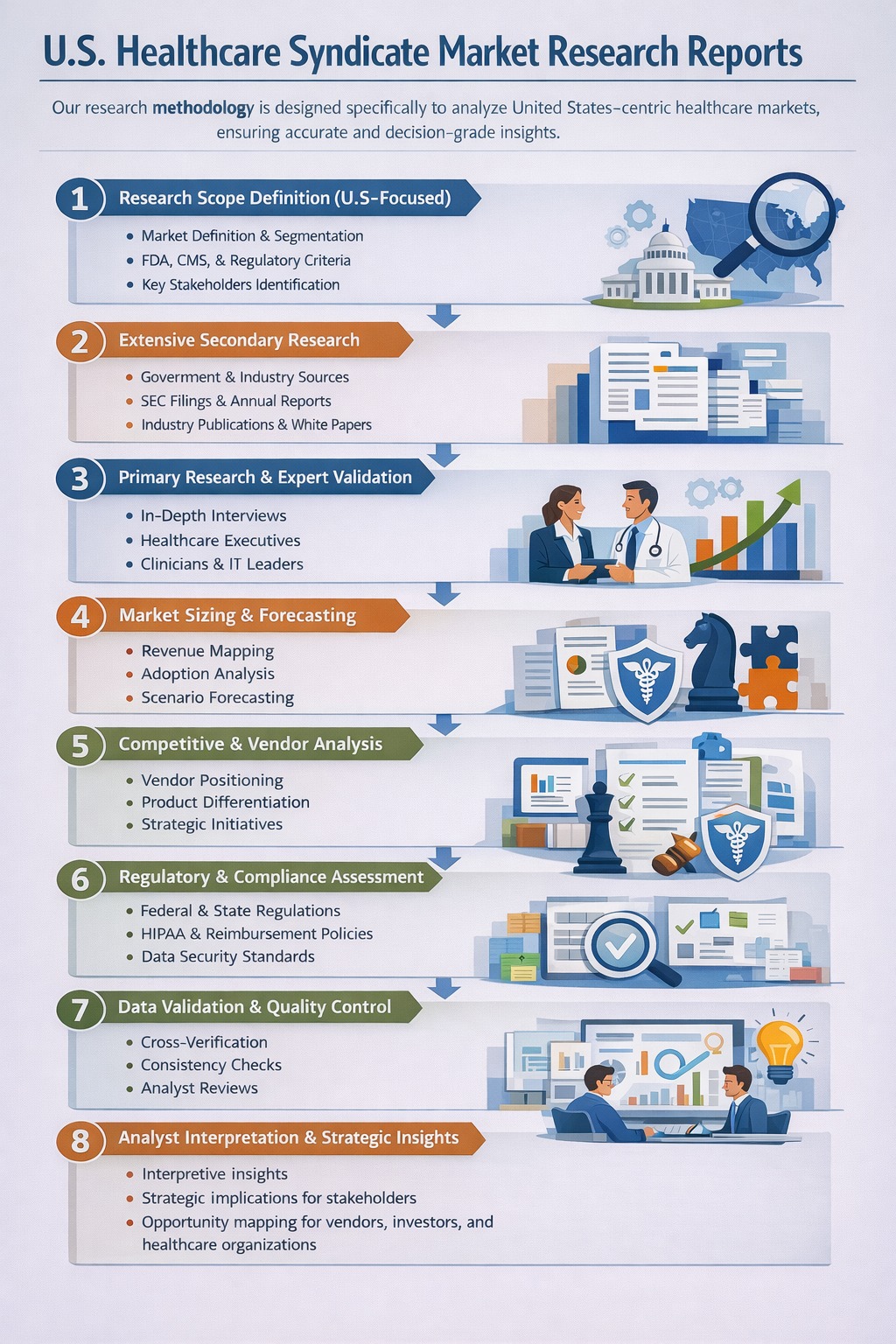
1.3 Research Methodology
1.3.1 Primary Data Collection
1.3.2 Secondary Data Sourcing
1.3.3 External Industry Collaborations
1.3.4 In-House Research Databases
1.4 Analytical Frameworks & Forecasting Model
1.5 Data Validation & Final Report Publishing
1.6 Key Assumptions
1.7 Market Ecosystem Overview
1.8 Stakeholder Analysis
1.8.1 MDR Service Providers
1.8.2 Healthcare Providers (Hospitals & IDNs)
1.8.3 Health Insurance Providers
1.8.4 Pharmaceutical & Biotechnology Companies
1.8.5 Cloud Infrastructure Providers
1.8.6 Regulatory Authorities
What this section provides: Introduces the market scope, research framework, definitions, data reliability process, and outlines the MDR ecosystem within U.S. healthcare cybersecurity infrastructure.
2. U.S. Healthcare Managed Detection and Response (MDR) Services Market: Executive Summary
2.1 Key Insights & Market Snapshot
2.2 Market Size Analysis (2025)
2.3 Market Forecast (2026–2035)
2.4 CAGR & Growth Highlights
2.5 Segmental Leadership Overview
2.6 Regional Leadership Overview
2.7 Analyst Viewpoint
2.8 Market Attractiveness Index
What this section provides: Presents a concise summary of growth projections, segment leaders, regional dominance, and strategic highlights for executive-level decision-making.
3. U.S. Healthcare Managed Detection and Response (MDR) Services Market: Market Dynamics & Outlook
3.1 Market Drivers
3.1.1 Rising Ransomware Attacks in Healthcare
3.1.2 Cloud & Hybrid IT Adoption
3.1.3 Regulatory & Compliance Mandates
3.1.4 Cyber Insurance Requirements
3.2 Market Restraints
3.2.1 Budget Constraints in Rural Healthcare Facilities
3.2.2 Integration & Legacy System Challenges
3.3 Market Opportunities
3.3.1 AI-Driven MDR Platforms
3.3.2 Zero Trust Architecture Expansion
3.3.3 Telehealth & Digital Health Security Growth
3.4 Innovation & Patent Landscape (2020–2025)
What this section provides: Explains major drivers, restraints, and opportunities shaping market growth while analyzing innovation trends and risk factors.
4. U.S. Healthcare Managed Detection and Response (MDR) Services Market: Market Environment & Industry Analysis
4.1 PESTEL Analysis
4.1.1 Political
4.1.2 Economic
4.1.3 Social
4.1.4 Technological
4.1.5 Environmental
4.1.6 Legal
4.2 Porter’s Five Forces Analysis
4.2.1 Threat of New Entrants
4.2.2 Bargaining Power of Buyers
4.2.3 Bargaining Power of Suppliers
4.2.4 Threat of Substitutes
4.2.5 Competitive Rivalry
4.3 Pricing Trend Analysis (2024–2030)
4.4 Value Chain & Supply Chain Analysis
4.5 Regulatory Framework Analysis (HIPAA, HITECH, CISA Guidelines)
4.6 Impact of Escalating Cyber Warfare & Geopolitical Risks
What this section provides: Delivers macro-environmental evaluation, competitive intensity assessment, regulatory overview, and pricing analysis impacting MDR services in U.S. healthcare.
SEGMENTATION ANALYSIS
5. U.S. Healthcare Managed Detection and Response (MDR) Services Market – By Security Type
5.1 Overview
5.2 Segment Share Analysis, By Security Type, 2025 & 2035 (%)
5.3 Endpoint Detection & Response (EDR)
5.4 Network Detection & Response (NDR)
5.5 Cloud Security & Workload Protection
5.6 Identity Threat Detection & Response (ITDR)
What this section provides: Breaks down the market by security architecture, highlighting dominant and fastest-growing cybersecurity frameworks in healthcare.
6. U.S. Healthcare Managed Detection and Response (MDR) Services Market – By Deployment Model
6.1 Overview
6.2 Segment Share Analysis, By Deployment Model, 2025 & 2035 (%)
6.3 Cloud-Based MDR
6.4 On-Premise MDR
6.5 Hybrid Deployment
What this section provides: Analyzes deployment preferences across healthcare institutions and evaluates scalability and compliance considerations.
7. U.S. Healthcare Managed Detection and Response (MDR) Services Market – By Healthcare Vertical
7.1 Overview
7.2 Segment Share Analysis, By Healthcare Vertical, 2025 & 2035 (%)
7.3 Hospitals & Integrated Delivery Networks (IDNs)
7.4 Health Insurance Providers
7.5 Pharmaceutical & Biotechnology Companies
7.6 Diagnostic & Imaging Centers
7.7 Telehealth & Digital Health Providers
What this section provides: Identifies revenue-generating healthcare customer segments and highlights sector-specific cybersecurity demand trends.
8. U.S. Healthcare Managed Detection and Response (MDR) Services Market – By Threat Type
8.1 Overview
8.2 Segment Share Analysis, By Threat Type, 2025 & 2035 (%)
8.3 Ransomware
8.4 Phishing & Social Engineering
8.5 Insider Threats
8.6 Advanced Persistent Threats (APTs)
8.7 IoT & Medical Device Exploits
What this section provides: Details primary cybersecurity threats driving MDR demand across U.S. healthcare environments.
9. U.S. Healthcare Managed Detection and Response (MDR) Services Market – By Geography
9.1 Introduction
9.2 Segment Share Analysis, By Geography, 2025 & 2035 (%)
9.3 West Region
9.3.1 Regional Overview & Trends
9.3.2 Market Size & Forecast, 2025–2035 (US$ Million)
9.3.3 By Security Type
9.3.4 By Deployment Model
9.3.5 By Healthcare Vertical
9.3.6 By Threat Type
9.3.7 California
9.3.7.1 Overview
9.3.7.2 Market Size & Forecast (2025–2035)
9.3.8 Washington
9.3.9 Colorado
9.3.10 Arizona
9.3.11 Oregon
9.3.12 Others
9.3.12.1 Nevada
9.3.12.2 Utah
9.3.12.3 New Mexico
9.3.12.4 Idaho
9.3.12.5 Montana
9.3.12.6 Wyoming
9.3.12.7 Alaska
9.3.12.8 Hawaii
9.4 Northeast
9.4.1 Regional Overview & Trends
9.4.2 New York
9.4.3 Massachusetts
9.4.4 New Jersey
9.4.5 Pennsylvania
9.4.6 Connecticut
9.4.7 Others
9.4.7.1 Maine
9.4.7.2 Vermont
9.4.7.3 New Hampshire
9.4.7.4 Rhode Island
9.4.7.5 Delaware
9.5 South
9.5.1 Regional Overview & Trends
9.5.2 Texas
9.5.3 Florida
9.5.4 Georgia
9.5.5 North Carolina
9.5.6 Tennessee
9.5.7 South Carolina
9.5.8 Alabama
9.5.9 Others
9.5.9.1 Mississippi
9.5.9.2 Louisiana
9.5.9.3 Arkansas
9.5.9.4 Kentucky
9.5.9.5 Oklahoma
9.5.9.6 Maryland
9.5.9.7 Virginia
9.5.9.8 West Virginia
9.6 Midwest
9.6.1 Regional Overview & Trends
9.6.2 Illinois
9.6.3 Ohio
9.6.4 Michigan
9.6.5 Minnesota
9.6.6 Indiana
9.6.7 Wisconsin
9.6.8 Missouri
9.6.9 Others
9.6.9.1 Iowa
9.6.9.2 Kansas
9.6.9.3 Nebraska
9.6.9.4 North Dakota
9.6.9.5 South Dakota
What this section provides: Offers detailed regional and state-level analysis to identify growth hotspots, cybersecurity investment trends, and market potential across all U.S. regions.
10. U.S. Healthcare Managed Detection and Response (MDR) Services Market: Competitive Landscape & Company Profiles
10.1 Market Share Analysis (2025)
10.2 Company Positioning Matrix
10.3 Company Profiles
10.3.1 CrowdStrike
10.3.2 Palo Alto Networks
10.3.3 Microsoft Security
10.3.4 IBM Security
10.3.5 Cisco Secure
10.3.6 SentinelOne
10.3.7 Rapid7
10.3.8 Arctic Wolf
10.3.9 Secureworks
10.3.10 Sophos
10.3.11 Trend Micro
10.3.12 Fortinet
10.3.13 Optiv
10.3.14 GuidePoint Security
10.3.15 Trellix
10.3.16 eSentire
10.3.17 BlackBerry Cybersecurity
10.3.18 Cybereason
10.3.19 Trustwave
10.3.20 Secureworks
What this section provides: Evaluates key competitors, strategic positioning, market share distribution, and competitive intensity within the U.S. healthcare MDR ecosystem.
11. U.S. Healthcare Managed Detection and Response (MDR) Services Market: Future Market Outlook (2025–2035)
11.1 Scenario Analysis (Optimistic, Realistic, Pessimistic)
11.2 Impact of AI & Automation
11.3 Emerging Business Models
11.4 Investment & M&A Trends
What this section provides: Presents forward-looking insights, growth scenarios, and disruptive trends shaping the next decade of MDR adoption.
12. U.S. Healthcare Managed Detection and Response (MDR) Services Market: Strategic Recommendations
12.1 Recommendations for MDR Providers
12.2 Recommendations for Healthcare Providers
12.3 Recommendations for Investors
What this section provides: Offers actionable strategic guidance to maximize growth opportunities and mitigate cybersecurity risks.
13. U.S. Healthcare Managed Detection and Response (MDR) Services Market: Disclaimer
What this section provides: States legal boundaries, data limitations, and report usage conditions.
List of Tables
TABLE 1: List of Data Sources
TABLE 2: Market Drivers; Impact Analysis
TABLE 3: Market Restraints; Impact Analysis
TABLE 4: U.S. Healthcare Managed Detection and Response (MDR) Services Market: Security Type Snapshot (2025)
TABLE 5: Segment Dashboard; Definition and Scope, by Security Type
TABLE 6: U.S. Healthcare Managed Detection and Response (MDR) Services Market, by Security Type, 2022–2035 (USD Million)
TABLE 7: U.S. Healthcare Managed Detection and Response (MDR) Services Market: Deployment Model Snapshot (2025)
TABLE 8: Segment Dashboard; Definition and Scope, by Deployment Model
TABLE 9: U.S. Healthcare Managed Detection and Response (MDR) Services Market, by Deployment Model, 2022–2035 (USD Million)
TABLE 10: U.S. Healthcare Managed Detection and Response (MDR) Services Market: Healthcare Vertical Snapshot (2025)
TABLE 11: Segment Dashboard; Definition and Scope, by Healthcare Vertical
TABLE 12: U.S. Healthcare Managed Detection and Response (MDR) Services Market, by Healthcare Vertical, 2022–2035 (USD Million)
TABLE 13: U.S. Healthcare Managed Detection and Response (MDR) Services Market: Threat Type Snapshot (2025)
TABLE 14: Segment Dashboard; Definition and Scope, by Threat Type
TABLE 15: U.S. Healthcare Managed Detection and Response (MDR) Services Market, by Threat Type, 2022–2035 (USD Million)
TABLE 16: U.S. Healthcare Managed Detection and Response (MDR) Services Market: Regional Snapshot (2025)
TABLE 17: Segment Dashboard; Definition and Scope, by Region
TABLE 18: U.S. Healthcare Managed Detection and Response (MDR) Services Market, by Region, 2022–2035 (USD Million)
TABLE 19: California Healthcare MDR Services Market, by Security Type, 2022–2035 (USD Million)
TABLE 20: California Healthcare MDR Services Market, by Deployment Model, 2022–2035 (USD Million)
TABLE 21: California Healthcare MDR Services Market, by Healthcare Vertical, 2022–2035 (USD Million)
TABLE 22: California Healthcare MDR Services Market, by Threat Type, 2022–2035 (USD Million)
TABLE 23: Washington Healthcare MDR Services Market, by Security Type, 2022–2035 (USD Million)
TABLE 24: Washington Healthcare MDR Services Market, by Deployment Model, 2022–2035 (USD Million)
TABLE 25: Washington Healthcare MDR Services Market, by Healthcare Vertical, 2022–2035 (USD Million)
TABLE 26: Washington Healthcare MDR Services Market, by Threat Type, 2022–2035 (USD Million)
TABLE 27: Colorado Healthcare MDR Services Market, by Security Type, 2022–2035 (USD Million)
TABLE 28: Colorado Healthcare MDR Services Market, by Deployment Model, 2022–2035 (USD Million)
TABLE 29: Colorado Healthcare MDR Services Market, by Healthcare Vertical, 2022–2035 (USD Million)
TABLE 30: Colorado Healthcare MDR Services Market, by Threat Type, 2022–2035 (USD Million)
TABLE 31: Arizona Healthcare MDR Services Market, by Security Type, 2022–2035 (USD Million)
TABLE 32: Arizona Healthcare MDR Services Market, by Deployment Model, 2022–2035 (USD Million)
TABLE 33: Arizona Healthcare MDR Services Market, by Healthcare Vertical, 2022–2035 (USD Million)
TABLE 34: Arizona Healthcare MDR Services Market, by Threat Type, 2022–2035 (USD Million)
TABLE 35: Oregon Healthcare MDR Services Market, by Security Type, 2022–2035 (USD Million)
TABLE 36: Oregon Healthcare MDR Services Market, by Deployment Model, 2022–2035 (USD Million)
TABLE 37: Oregon Healthcare MDR Services Market, by Healthcare Vertical, 2022–2035 (USD Million)
TABLE 38: Oregon Healthcare MDR Services Market, by Threat Type, 2022–2035 (USD Million)
TABLE 39: West – Others Healthcare MDR Services Market, by Security Type, 2022–2035 (USD Million)
TABLE 40: West – Others Healthcare MDR Services Market, by Deployment Model, 2022–2035 (USD Million)
TABLE 41: West – Others Healthcare MDR Services Market, by Healthcare Vertical, 2022–2035 (USD Million)
TABLE 42: West – Others Healthcare MDR Services Market, by Threat Type, 2022–2035 (USD Million)
TABLE 43: New York Healthcare MDR Services Market, by Security Type, 2022–2035 (USD Million)
TABLE 44: New York Healthcare MDR Services Market, by Deployment Model, 2022–2035 (USD Million)
TABLE 45: New York Healthcare MDR Services Market, by Healthcare Vertical, 2022–2035 (USD Million)
TABLE 46: New York Healthcare MDR Services Market, by Threat Type, 2022–2035 (USD Million)
TABLE 47: Massachusetts Healthcare MDR Services Market, by Security Type, 2022–2035 (USD Million)
TABLE 48: Massachusetts Healthcare MDR Services Market, by Deployment Model, 2022–2035 (USD Million)
TABLE 49: Massachusetts Healthcare MDR Services Market, by Healthcare Vertical, 2022–2035 (USD Million)
TABLE 50: Massachusetts Healthcare MDR Services Market, by Threat Type, 2022–2035 (USD Million)
TABLE 51: New Jersey Healthcare MDR Services Market, by Security Type, 2022–2035 (USD Million)
TABLE 52: New Jersey Healthcare MDR Services Market, by Deployment Model, 2022–2035 (USD Million)
TABLE 53: New Jersey Healthcare MDR Services Market, by Healthcare Vertical, 2022–2035 (USD Million)
TABLE 54: New Jersey Healthcare MDR Services Market, by Threat Type, 2022–2035 (USD Million)
TABLE 55: Pennsylvania Healthcare MDR Services Market, by Security Type, 2022–2035 (USD Million)
TABLE 56: Pennsylvania Healthcare MDR Services Market, by Deployment Model, 2022–2035 (USD Million)
TABLE 57: Pennsylvania Healthcare MDR Services Market, by Healthcare Vertical, 2022–2035 (USD Million)
TABLE 58: Pennsylvania Healthcare MDR Services Market, by Threat Type, 2022–2035 (USD Million)
TABLE 59: Connecticut Healthcare MDR Services Market, by Security Type, 2022–2035 (USD Million)
TABLE 60: Connecticut Healthcare MDR Services Market, by Deployment Model, 2022–2035 (USD Million)
TABLE 61: Connecticut Healthcare MDR Services Market, by Healthcare Vertical, 2022–2035 (USD Million)
TABLE 62: Connecticut Healthcare MDR Services Market, by Threat Type, 2022–2035 (USD Million)
TABLE 63: Northeast – Others Healthcare MDR Services Market, by Security Type, 2022–2035 (USD Million)
TABLE 64: Northeast – Others Healthcare MDR Services Market, by Deployment Model, 2022–2035 (USD Million)
TABLE 65: Northeast – Others Healthcare MDR Services Market, by Healthcare Vertical, 2022–2035 (USD Million)
TABLE 66: Northeast – Others Healthcare MDR Services Market, by Threat Type, 2022–2035 (USD Million)
TABLE 67: Texas Healthcare MDR Services Market, by Security Type, 2022–2035 (USD Million)
TABLE 68: Texas Healthcare MDR Services Market, by Deployment Model, 2022–2035 (USD Million)
TABLE 69: Texas Healthcare MDR Services Market, by Healthcare Vertical, 2022–2035 (USD Million)
TABLE 70: Texas Healthcare MDR Services Market, by Threat Type, 2022–2035 (USD Million)
TABLE 71: Florida Healthcare MDR Services Market, by Security Type, 2022–2035 (USD Million)
TABLE 72: Florida Healthcare MDR Services Market, by Deployment Model, 2022–2035 (USD Million)
TABLE 73: Florida Healthcare MDR Services Market, by Healthcare Vertical, 2022–2035 (USD Million)
TABLE 74: Florida Healthcare MDR Services Market, by Threat Type, 2022–2035 (USD Million)
TABLE 75: Georgia Healthcare MDR Services Market, by Security Type, 2022–2035 (USD Million)
TABLE 76: Georgia Healthcare MDR Services Market, by Deployment Model, 2022–2035 (USD Million)
TABLE 77: Georgia Healthcare MDR Services Market, by Healthcare Vertical, 2022–2035 (USD Million)
TABLE 78: Georgia Healthcare MDR Services Market, by Threat Type, 2022–2035 (USD Million)
TABLE 79: North Carolina Healthcare MDR Services Market, by Security Type, 2022–2035 (USD Million)
TABLE 80: North Carolina Healthcare MDR Services Market, by Deployment Model, 2022–2035 (USD Million)
TABLE 81: North Carolina Healthcare MDR Services Market, by Healthcare Vertical, 2022–2035 (USD Million)
TABLE 82: North Carolina Healthcare MDR Services Market, by Threat Type, 2022–2035 (USD Million)
TABLE 83: Tennessee Healthcare MDR Services Market, by Security Type, 2022–2035 (USD Million)
TABLE 84: Tennessee Healthcare MDR Services Market, by Deployment Model, 2022–2035 (USD Million)
TABLE 85: Tennessee Healthcare MDR Services Market, by Healthcare Vertical, 2022–2035 (USD Million)
TABLE 86: Tennessee Healthcare MDR Services Market, by Threat Type, 2022–2035 (USD Million)
TABLE 87: South Carolina Healthcare MDR Services Market, by Security Type, 2022–2035 (USD Million)
TABLE 88: South Carolina Healthcare MDR Services Market, by Deployment Model, 2022–2035 (USD Million)
TABLE 89: South Carolina Healthcare MDR Services Market, by Healthcare Vertical, 2022–2035 (USD Million)
TABLE 90: South Carolina Healthcare MDR Services Market, by Threat Type, 2022–2035 (USD Million)
TABLE 91: Alabama Healthcare MDR Services Market, by Security Type, 2022–2035 (USD Million)
TABLE 92: Alabama Healthcare MDR Services Market, by Deployment Model, 2022–2035 (USD Million)
TABLE 93: Alabama Healthcare MDR Services Market, by Healthcare Vertical, 2022–2035 (USD Million)
TABLE 94: Alabama Healthcare MDR Services Market, by Threat Type, 2022–2035 (USD Million)
TABLE 95: South – Others Healthcare MDR Services Market, by Security Type, 2022–2035 (USD Million)
TABLE 96: South – Others Healthcare MDR Services Market, by Deployment Model, 2022–2035 (USD Million)
TABLE 97: South – Others Healthcare MDR Services Market, by Healthcare Vertical, 2022–2035 (USD Million)
TABLE 98: South – Others Healthcare MDR Services Market, by Threat Type, 2022–2035 (USD Million)
TABLE 99: Illinois Healthcare MDR Services Market, by Security Type, 2022–2035 (USD Million)
TABLE 100: Illinois Healthcare MDR Services Market, by Deployment Model, 2022–2035 (USD Million)
TABLE 101: Illinois Healthcare MDR Services Market, by Healthcare Vertical, 2022–2035 (USD Million)
TABLE 102: Illinois Healthcare MDR Services Market, by Threat Type, 2022–2035 (USD Million)
TABLE 103: Ohio Healthcare MDR Services Market, by Security Type, 2022–2035 (USD Million)
TABLE 104: Ohio Healthcare MDR Services Market, by Deployment Model, 2022–2035 (USD Million)
TABLE 105: Ohio Healthcare MDR Services Market, by Healthcare Vertical, 2022–2035 (USD Million)
TABLE 106: Ohio Healthcare MDR Services Market, by Threat Type, 2022–2035 (USD Million)
TABLE 107: Michigan Healthcare MDR Services Market, by Security Type, 2022–2035 (USD Million)
TABLE 108: Michigan Healthcare MDR Services Market, by Deployment Model, 2022–2035 (USD Million)
TABLE 109: Michigan Healthcare MDR Services Market, by Healthcare Vertical, 2022–2035 (USD Million)
TABLE 110: Michigan Healthcare MDR Services Market, by Threat Type, 2022–2035 (USD Million)
TABLE 111: Minnesota Healthcare MDR Services Market, by Security Type, 2022–2035 (USD Million)
TABLE 112: Minnesota Healthcare MDR Services Market, by Deployment Model, 2022–2035 (USD Million)
TABLE 113: Minnesota Healthcare MDR Services Market, by Healthcare Vertical, 2022–2035 (USD Million)
TABLE 114: Minnesota Healthcare MDR Services Market, by Threat Type, 2022–2035 (USD Million)
TABLE 115: Indiana Healthcare MDR Services Market, by Security Type, 2022–2035 (USD Million)
TABLE 116: Indiana Healthcare MDR Services Market, by Deployment Model, 2022–2035 (USD Million)
TABLE 117: Indiana Healthcare MDR Services Market, by Healthcare Vertical, 2022–2035 (USD Million)
TABLE 118: Indiana Healthcare MDR Services Market, by Threat Type, 2022–2035 (USD Million)
TABLE 119: Wisconsin Healthcare MDR Services Market, by Security Type, 2022–2035 (USD Million)
TABLE 120: Wisconsin Healthcare MDR Services Market, by Deployment Model, 2022–2035 (USD Million)
TABLE 121: Wisconsin Healthcare MDR Services Market, by Healthcare Vertical, 2022–2035 (USD Million)
TABLE 122: Wisconsin Healthcare MDR Services Market, by Threat Type, 2022–2035 (USD Million)
TABLE 123: Missouri Healthcare MDR Services Market, by Security Type, 2022–2035 (USD Million)
TABLE 124: Missouri Healthcare MDR Services Market, by Deployment Model, 2022–2035 (USD Million)
TABLE 125: Missouri Healthcare MDR Services Market, by Healthcare Vertical, 2022–2035 (USD Million)
TABLE 126: Missouri Healthcare MDR Services Market, by Threat Type, 2022–2035 (USD Million)
TABLE 127: Midwest – Others Healthcare MDR Services Market, by Security Type, 2022–2035 (USD Million)
TABLE 128: Midwest – Others Healthcare MDR Services Market, by Deployment Model, 2022–2035 (USD Million)
TABLE 129: Midwest – Others Healthcare MDR Services Market, by Healthcare Vertical, 2022–2035 (USD Million)
TABLE 130: Midwest – Others Healthcare MDR Services Market, by Threat Type, 2022–2035 (USD Million)
List of Figures
FIGURE 1: U.S. Healthcare Managed Detection and Response (MDR) Services Market Segmentation
FIGURE 2: Market Research Methodology
FIGURE 3: Value Chain Analysis
FIGURE 4: PESTLE Analysis
FIGURE 5: Porter’s Five Forces Analysis
FIGURE 6: Market Attractiveness Analysis
FIGURE 7: Market Dynamics
FIGURE 8: Innovation & Cybersecurity Patent Landscape (2020–2024)
FIGURE 9: Competitive Landscape; Key Company Market Share Analysis, 2025
FIGURE 10: Security Type Segment Market Share Analysis, 2025 & 2035
FIGURE 11: Security Type Segment Market Size Forecast and Trend Analysis, 2025–2035 (USD Million)
FIGURE 12: Deployment Model Segment Market Share Analysis, 2025 & 2035
FIGURE 13: Deployment Model Segment Market Size Forecast and Trend Analysis, 2025–2035 (USD Million)
FIGURE 14: Healthcare Vertical Segment Market Share Analysis, 2025 & 2035
FIGURE 15: Healthcare Vertical Segment Market Size Forecast and Trend Analysis, 2025–2035 (USD Million)
FIGURE 16: Threat Type Segment Market Share Analysis, 2025 & 2035
FIGURE 17: Threat Type Segment Market Size Forecast and Trend Analysis, 2025–2035 (USD Million)
FIGURE 18: Regional Segment Market Share Analysis, 2025 & 2035
FIGURE 19: Regional Segment Market Size Forecast and Trend Analysis, 2025–2035 (USD Million)
FIGURE 20: West Region Healthcare MDR Market Share and Leading Players, 2025
FIGURE 21: Northeast Region Healthcare MDR Market Share and Leading Players, 2025
FIGURE 22: South Region Healthcare MDR Market Share and Leading Players, 2025
FIGURE 23: Midwest Region Healthcare MDR Market Share and Leading Players, 2025
FIGURE 24: West Region Market Share Analysis by State, 2025
FIGURE 25: California Healthcare MDR Services Market Size, Forecast and Trend Analysis, 2025–2035 (USD Million)
FIGURE 26: Washington Healthcare MDR Services Market Size, Forecast and Trend Analysis, 2025–2035 (USD Million)
FIGURE 27: Colorado Healthcare MDR Services Market Size, Forecast and Trend Analysis, 2025–2035 (USD Million)
FIGURE 28: Arizona Healthcare MDR Services Market Size, Forecast and Trend Analysis, 2025–2035 (USD Million)
FIGURE 29: Oregon Healthcare MDR Services Market Size, Forecast and Trend Analysis, 2025–2035 (USD Million)
FIGURE 30: Others (West Region) Healthcare MDR Services Market Size, Forecast and Trend Analysis, 2025–2035 (USD Million)
FIGURE 31: South Region Market Share Analysis by State, 2025
FIGURE 32: Texas Healthcare MDR Services Market Size, Forecast and Trend Analysis, 2025–2035 (USD Million)
FIGURE 33: Florida Healthcare MDR Services Market Size, Forecast and Trend Analysis, 2025–2035 (USD Million)
FIGURE 34: Georgia Healthcare MDR Services Market Size, Forecast and Trend Analysis, 2025–2035 (USD Million)
FIGURE 35: North Carolina Healthcare MDR Services Market Size, Forecast and Trend Analysis, 2025–2035 (USD Million)
FIGURE 36: Tennessee Healthcare MDR Services Market Size, Forecast and Trend Analysis, 2025–2035 (USD Million)
FIGURE 37: South Carolina Healthcare MDR Services Market Size, Forecast and Trend Analysis, 2025–2035 (USD Million)
FIGURE 38: Alabama Healthcare MDR Services Market Size, Forecast and Trend Analysis, 2025–2035 (USD Million)
FIGURE 39: Others (South Region) Healthcare MDR Services Market Size, Forecast and Trend Analysis, 2025–2035 (USD Million)
FIGURE 40: Midwest Region Market Share Analysis by State, 2025
FIGURE 41: Illinois Healthcare MDR Services Market Size, Forecast and Trend Analysis, 2025–2035 (USD Million)
FIGURE 42: Ohio Healthcare MDR Services Market Size, Forecast and Trend Analysis, 2025–2035 (USD Million)
FIGURE 43: Michigan Healthcare MDR Services Market Size, Forecast and Trend Analysis, 2025–2035 (USD Million)
FIGURE 44: Minnesota Healthcare MDR Services Market Size, Forecast and Trend Analysis, 2025–2035 (USD Million)
FIGURE 45: Indiana Healthcare MDR Services Market Size, Forecast and Trend Analysis, 2025–2035 (USD Million)
FIGURE 46: Wisconsin Healthcare MDR Services Market Size, Forecast and Trend Analysis, 2025–2035 (USD Million)
FIGURE 47: Missouri Healthcare MDR Services Market Size, Forecast and Trend Analysis, 2025–2035 (USD Million)
FIGURE 48: Others (Midwest Region) Healthcare MDR Services Market Size, Forecast and Trend Analysis, 2025–2035 (USD Million)
FIGURE 49: Northeast Region Market Share Analysis by State, 2025
FIGURE 50: New York Healthcare MDR Services Market Size, Forecast and Trend Analysis, 2025–2035 (USD Million)
FIGURE 51: Massachusetts Healthcare MDR Services Market Size, Forecast and Trend Analysis, 2025–2035 (USD Million)
FIGURE 52: New Jersey Healthcare MDR Services Market Size, Forecast and Trend Analysis, 2025–2035 (USD Million)
FIGURE 53: Pennsylvania Healthcare MDR Services Market Size, Forecast and Trend Analysis, 2025–2035 (USD Million)
FIGURE 54: Connecticut Healthcare MDR Services Market Size, Forecast and Trend Analysis, 2025–2035 (USD Million)
FIGURE 55: Others (Northeast Region) Healthcare MDR Services Market Size, Forecast and Trend Analysis, 2025–2035 (USD Million)