
Market Outlook
By 2035, the U.S. Healthcare Cybersecurity Market is projected to reach USD 52.7 billion, expanding at a CAGR of 17.3% from 2026–2035. The market, valued at USD 12.4 billion in 2025, is driven by a surge in ransomware attacks, data breaches, and HIPAA compliance mandates across hospitals, payers, and life sciences companies.
The healthcare sector accounts for nearly 28% of all ransomware attacks in the United States, according to HHS Cybersecurity reports. Growing interconnectivity, through IoMT (Internet of Medical Things), cloud adoption, and digital health expansion, has elevated cyber risk, pushing healthcare organizations to implement advanced AI-based cybersecurity, zero-trust architectures, and data encryption solutions.
As the U.S. healthcare ecosystem becomes increasingly digital, cyber resilience is no longer optional, it’s a core strategic pillar for patient safety, regulatory compliance, and institutional trust.
Introduction
According to the U.S. Healthcare Cybersecurity Market Report (2026–2035), the sector faces unprecedented cyber threats targeting medical records, connected medical devices, and hospital networks. Data breaches in the healthcare sector are among the costliest, averaging USD 10.9 million per incident (IBM, 2025), nearly double the global average.
The increasing use of electronic health records (EHRs), telehealth, and remote patient monitoring solutions has widened the attack surface, creating urgency for advanced security frameworks that combine threat intelligence, real-time monitoring, and automated incident response.
Key U.S. cybersecurity policies such as HIPAA, HITECH, and the CISA Healthcare Sector Cybersecurity Framework are reinforcing compliance-based defense investments, especially among hospitals, insurers, and pharma manufacturers.
Key Market Drivers: What’s Fueling the U.S. Healthcare Cybersecurity Market Boom?
- Escalating Cyber Threats to Healthcare Infrastructure
The U.S. healthcare system faces rising threats from ransomware, phishing, and supply chain attacks. In 2025 alone, over 133 million patient records were compromised. Hospitals and payers are prioritizing endpoint detection and response (EDR), network segmentation, and cloud-based threat analytics to reduce vulnerabilities. - Rapid Digitalization & IoMT Adoption
The U.S. has over 25 billion connected healthcare devices (IoMT) as of 2026, each representing a potential entry point for hackers. Real-time cybersecurity monitoring and firmware integrity checks are increasingly integrated into device lifecycle management to safeguard patient data. - Stringent Compliance & Federal Initiatives
Regulatory bodies such as HHS, CISA, and NIST are mandating baseline security controls for healthcare entities. Programs like the HHS 405(d) Health Industry Cybersecurity Practices (HICP) framework are pushing hospitals to adopt stronger cybersecurity maturity models. - Cloud & AI Integration
AI-driven security solutions, capable of predictive threat detection and automated response, are driving adoption. Cloud-native SIEM (Security Information and Event Management) platforms from vendors like Microsoft and Palo Alto Networks now dominate hospital network deployments. - Workforce Shortage & Managed Security Services
A lack of skilled cybersecurity personnel in healthcare (estimated shortfall of 45,000 professionals in 2026) has accelerated outsourcing to managed security service providers (MSSPs) specializing in HIPAA-compliant protection.
Innovation in Focus: How Vendors Are Redefining Healthcare Security
Leading cybersecurity firms are integrating AI-driven analytics, zero-trust frameworks, and decentralized encryption to meet healthcare’s evolving threat landscape. Innovations include:
- Blockchain-secured EHR sharing for verifiable data access
- Behavioral anomaly detection systems that learn from clinician workflows
- Post-quantum encryption protocols under pilot testing in major hospital networks
- Federated learning models that secure medical data while enabling machine learning without sharing patient records
These advances are redefining how U.S. healthcare organizations balance security with operational continuity and interoperability.
Recent Developments
- 2025–2026: HHS launched a Cybersecurity Performance Goals (CPGs) framework, mandating baseline risk management for hospitals.
- Microsoft & CISA Partnership: Established a Healthcare Cyber Defense Network for threat intelligence sharing.
- IBM & Mayo Clinic Collaboration: Introduced a blockchain-based patient data protection prototype.
- Palo Alto Networks: Released HIPAA-ready zero-trust architecture for multi-cloud hospital networks.
- CrowdStrike: Introduced autonomous threat response systems customized for EHR ecosystems.
Conclusion
The U.S. Healthcare Cybersecurity Market is undergoing structural transformation. Cybersecurity has evolved from an IT function to a core clinical safety imperative. As the U.S. healthcare landscape becomes more digital, interconnected, and data-driven, investments in cloud-based threat intelligence, zero-trust networks, and AI-powered analytics will define the future of secure healthcare delivery.
With ongoing government support, rising attack sophistication, and growing interdependency between data and patient care, cybersecurity in healthcare is no longer an optional expense, it is the foundation of trust, resilience, and continuity for the nation’s healthcare system.
Key Market Players
The competitive landscape of the U.S. Healthcare Cybersecurity Market is moderately consolidated, comprising technology giants, specialized healthcare cybersecurity vendors, and managed service providers. Companies emphasize regulatory compliance, endpoint protection, and threat intelligence integration as differentiating factors.
- Palo Alto Networks – Leader in hospital network firewalls and zero-trust adoption across U.S. health systems.
- IBM Security – Expanding AI-powered QRadar SIEM and data encryption solutions tailored for HIPAA environments.
- Cisco Systems – Strengthening network security for hospital IoT devices and connected health systems.
- Fortinet – Providing unified threat management for multi-facility hospital networks.
- Check Point Software Technologies – Leading in secure cloud connectivity for healthcare SaaS applications.
- CrowdStrike – Popular for endpoint detection and threat hunting in hospital systems.
- Trend Micro – Offers IoMT security solutions for medical device networks.
- Proofpoint – Strong in phishing protection and healthcare email security.
- Okta – Dominant in identity and access management for healthcare workforces.
- Microsoft Azure Security – Provides cloud-native HIPAA-compliant cybersecurity ecosystems.
- Symantec (Broadcom) – Offering integrated data loss prevention and threat intelligence for healthcare.
- McAfee Enterprise – Focused on cloud-based endpoint security for insurers and hospitals.
- Sophos – Expanding healthcare-specific MDR (Managed Detection and Response) offerings.
- Armis Security – Specializes in securing connected medical devices (IoMT).
- CyberMDX – U.S.-based leader in clinical device cybersecurity.
- Claroty – Secures operational technology (OT) in healthcare manufacturing and pharma plants.
- FireEye (Trellix) – Known for breach response services in major hospital attacks.
- SentinelOne – Rapidly expanding across healthcare EDR deployments.
- Zscaler – Strength in zero-trust cloud architecture for distributed healthcare networks.
- Proofpoint – Focused on securing patient communications and email gateways in large U.S. hospital networks.
- Solutions (Dominant Segment): Includes endpoint protection, threat detection, identity management, and encryption software. High adoption in hospitals and payers for real-time network protection.
- Services (Fastest-Growing Segment): Managed detection and response (MDR), consulting, compliance audits, and incident response outsourcing drive rapid growth.
- Hardware: Network firewalls, secure gateways, and intrusion detection systems see steady demand, particularly in legacy on-premise hospital networks.
- Network Security (Dominant): Core to hospital operations; adoption of next-generation firewalls (NGFWs) and intrusion prevention systems (IPS).
- Cloud Security (Fastest Growing): Surge in telehealth and SaaS-based healthcare applications fuels investment.
- Endpoint Security: Growing importance with mobile device and IoMT security.
- Data Security: Advanced encryption, data loss prevention (DLP), and tokenization solutions to safeguard PHI (Protected Health Information).
- Application Security: Ensures secure APIs and medical software development.
- Cloud-based (Dominant & Fastest-Growing): HIPAA-compliant cloud adoption enables scalability and continuous threat intelligence updates.
- On-Premise: Favored by institutions handling highly sensitive military or genomic data.
- Hybrid: Increasingly preferred for integrating on-premises EHR systems with cloud analytics tools.
- Hospitals & Clinics (Dominant): Major targets for ransomware, driving robust investments in endpoint and network protection.
- Pharmaceutical & Biotech Companies (Fastest-Growing): Protecting intellectual property, R&D data, and manufacturing systems.
- Health Insurance Providers: Focused on preventing claims fraud and ensuring data privacy under HIPAA.
- Diagnostic Laboratories: Adopting secure cloud solutions for digital imaging and pathology data.
- Research & Academic Institutions: Securing clinical trial data and research collaboration platforms.
West Region (Dominant)
States Covered: California, Washington, Colorado, Arizona, Oregon, Nevada, Utah, Idaho, New Mexico, Alaska, Hawaii
- The West leads with over 35% market share, driven by California’s concentration of healthcare startups, cybersecurity firms, and hospital networks adopting AI-based protection.
- Los Angeles and San Francisco hospitals are pioneers in ransomware resilience programs.
- Washington and Oregon report high federal cybersecurity grants and strong adoption of zero-trust architecture in hospital systems.
- Arizona and Colorado are emerging MSSP hubs for healthcare data centers.
Northeast Region (Rapidly Expanding)
States Covered: New York, Massachusetts, New Jersey, Pennsylvania, Connecticut, Delaware, Rhode Island, Vermont, Maine, New Hampshire
- The Northeast benefits from academic medical centers such as Mass General Brigham and Mount Sinai, which are implementing advanced cyber defense systems.
- New York and Massachusetts are leaders in healthcare cybersecurity R&D collaborations.
- High breach incident rates in New Jersey and Pennsylvania have accelerated investment in EHR encryption and threat intelligence sharing consortiums.
South Region (Fastest-Growing)
States Covered: Texas, Florida, Georgia, North Carolina, Tennessee, South Carolina, Alabama, Virginia, Kentucky, Oklahoma, Arkansas, Louisiana, Maryland, West Virginia
- The South is projected to grow at a CAGR of 19.6%, driven by healthcare modernization and rapid telehealth expansion post-COVID-19.
- Texas hosts several cybersecurity innovation hubs, such as the Texas Cybersecurity Center for Health.
- Florida hospitals are prioritizing ransomware prevention following high-profile attacks in 2025.
- Georgia’s healthcare technology corridor is home to key players specializing in HIPAA-compliant MSSPs.
Midwest Region (Stable Growth)
States Covered: Illinois, Ohio, Michigan, Minnesota, Wisconsin, Missouri, Indiana, Iowa, Nebraska, Kansas, North & South Dakota
- The Midwest exhibits consistent growth as regional health systems consolidate cybersecurity infrastructure.
- Illinois and Minnesota lead in healthcare data analytics security frameworks.
- Ohio hospitals are early adopters of AI-based threat detection systems.
- State governments in Michigan and Wisconsin are funding cybersecurity resilience programs for rural healthcare facilities.
1. U.S. Healthcare Cybersecurity Market: Market Introduction & Context
1.1 Market Definition
1.2 Scope of the Study
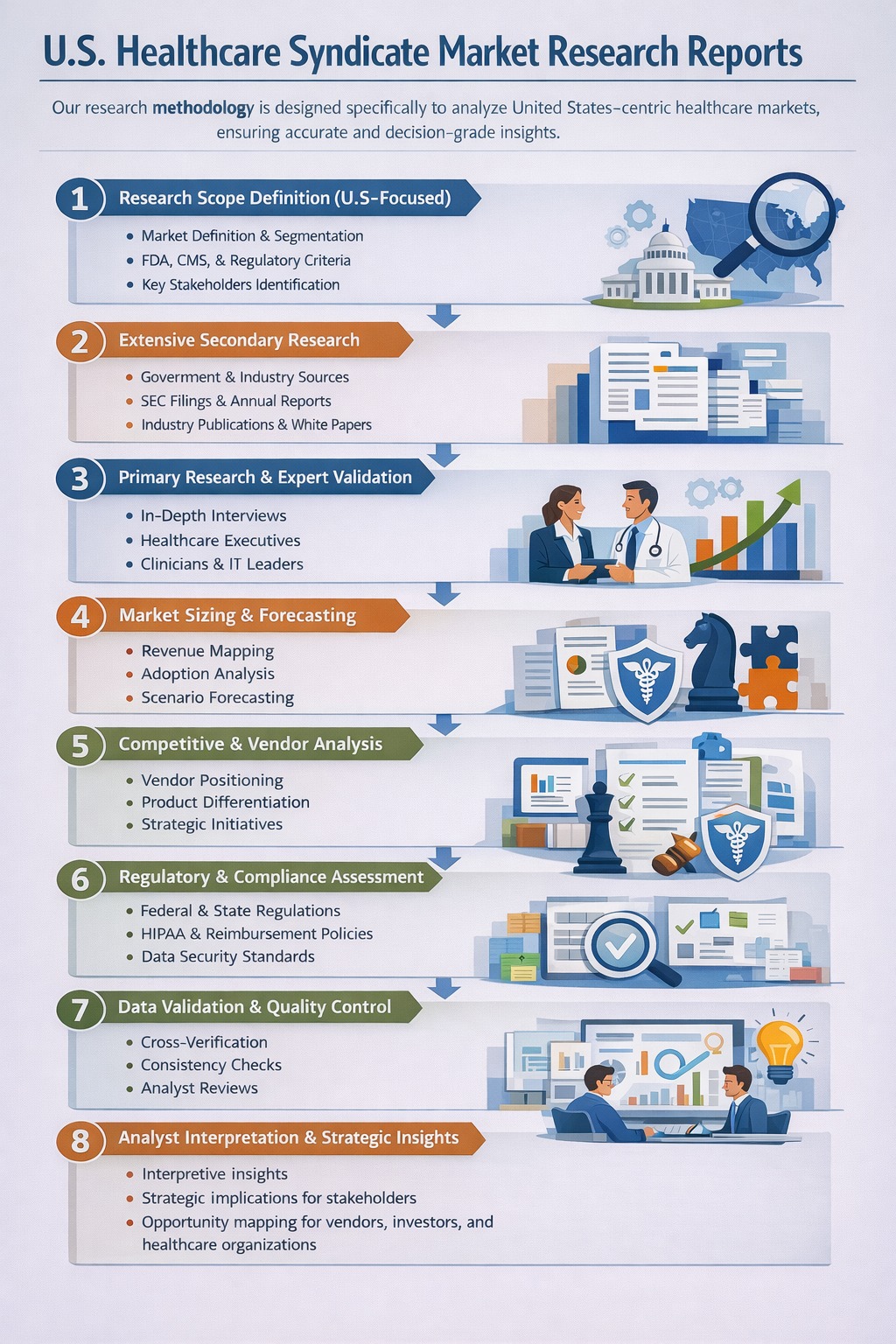
1.3 Research Methodology
1.3.1 Primary Data Collection
1.3.2 Secondary Data Sourcing
1.3.3 External Industry Collaborations
1.3.4 In-House Research Databases
1.3.5 Analytical Frameworks & Forecasting Methodologies
1.4 Data Validation and Final Report Publishing
1.5 Key Assumptions
1.6 Market Ecosystem Overview
1.7 Stakeholder Analysis (Cybersecurity Vendors, Healthcare Providers, MSSPs, Payers, and Regulators)
What this section provides:
Defines the scope, methodology, and assumptions, offering clarity on research structure, data reliability, and analytical framework.
2. U.S. Healthcare Cybersecurity Market: Executive Summary
2.1 Key Insights & Market Snapshots
2.2 Analyst Viewpoint
2.3 Market Attractiveness Index
What this section provides:
Summarizes key findings, forecasts, and strategic highlights, offering a quick overview of market direction and growth outlook.
3. U.S. Healthcare Cybersecurity Market: Market Dynamics & Outlook
3.1 Drivers and Their Impact Analysis
3.2 Restraints and Their Impact Analysis
3.3 Opportunities and Their Impact Analysis (Zero-Trust, AI Threat Analytics, IoMT Security)
3.4 Patent & Innovation Analysis (2020–2025)
What this section provides:
Analyzes drivers, restraints, and opportunities influencing growth, alongside emerging technology and innovation patterns.
4. U.S. Healthcare Cybersecurity Market: Market Environment & Industry Overview
4.1 PESTEL Analysis
4.1.1 Political
4.1.2 Economic
4.1.3 Social
4.1.4 Technological
4.1.5 Environmental
4.1.6 Legal
4.2 Porter’s Five Forces Analysis
4.2.1 Threat of New Entrants
4.2.2 Bargaining Power of Buyers
4.2.3 Bargaining Power of Suppliers
4.2.4 Substitution Risk
4.2.5 Competitive Rivalry
4.3 Pricing Trend Analysis by Region (2024–2030)
4.4 Value Chain & Supply Chain Analysis
4.5 Impact of Digitalization
4.6 Cybersecurity Application & Innovation Landscape
4.7 Regulatory Framework Analysis (HIPAA, HITECH, CISA, NIST)
4.8 Government Initiatives & Cyber Defense Policies
4.9 Impact of Geopolitical Tensions on Cyber Threat Landscape
What this section provides:
Provides a complete view of industry dynamics, covering regulatory environment, competitive forces, and external market drivers.
5. U.S. Healthcare Cybersecurity Market – By Component
5.1 Overview
5.2 Segment Share Analysis, By Component, 2025 & 2035 (%)
5.2.1 Solutions (Threat Detection, Encryption, Identity Management)
5.2.2 Services (Managed Detection, Compliance Auditing, Consulting)
5.2.3 Hardware (Firewalls, Secure Gateways, Network Appliances)
What this section provides:
Breaks down the market by component, guiding stakeholders on which cybersecurity categories are driving adoption.
6. U.S. Healthcare Cybersecurity Market – By Security Type
6.1 Overview
6.2 Segment Share Analysis, By Security Type, 2025 & 2035 (%)
6.2.1 Network Security
6.2.2 Cloud Security
6.2.3 Endpoint Security
6.2.4 Data Security
6.2.5 Application Security
What this section provides:
Explores major cybersecurity types in healthcare, helping identify risk protection areas gaining the most investment.
7. U.S. Healthcare Cybersecurity Market – By Deployment Mode
7.1 Overview
7.2 Segment Share Analysis, By Deployment Mode, 2025 & 2035 (%)
7.2.1 On-Premise
7.2.2 Cloud-Based
7.2.3 Hybrid
What this section provides:
Highlights the adoption patterns of on-premise, hybrid, and cloud-based cybersecurity frameworks.
8. U.S. Healthcare Cybersecurity Market – By End User
8.1 Overview
8.2 Segment Share Analysis, By End User, 2025 & 2035 (%)
8.2.1 Hospitals & Clinics
8.2.2 Pharmaceutical & Biotechnology Companies
8.2.3 Health Insurance Providers
8.2.4 Diagnostic Laboratories
8.2.5 Research & Academic Institutions
What this section provides:
Explains cybersecurity usage and spending patterns by end-user category within the U.S. healthcare system.
9. U.S. Healthcare Cybersecurity Market – By Geography
9.1 Introduction
9.2 Segment Share Analysis, By Geography, 2025 & 2035 (%)
9.3 West Region
9.3.1 Regional Overview & Trends
9.3.2 Market Size & Forecast by State (2025–2035, USD Million)
9.3.2.1 California
9.3.2.2 Washington
9.3.2.3 Colorado
9.3.2.4 Arizona
9.3.2.5 Oregon
9.3.2.6 Others (Utah, Nevada, New Mexico, Idaho, Montana, Wyoming, Alaska, Hawaii)
What this section provides:
Analyzes cybersecurity trends, state-level adoption, and digital risk management strategies across the western United States.
9.4 Northeast Region
9.4.1 Regional Overview & Trends
9.4.2 Market Size & Forecast by State (2025–2035, USD Million)
9.4.2.1 New York
9.4.2.2 Massachusetts
9.4.2.3 New Jersey
9.4.2.4 Pennsylvania
9.4.2.5 Connecticut
9.4.2.6 Others (Maine, Vermont, New Hampshire, Rhode Island, Delaware)
What this section provides:
Covers market growth and security advancements across the Northeast, emphasizing healthcare data compliance and protection.
9.5 South Region
9.5.1 Regional Overview & Trends
9.5.2 Market Size & Forecast by State (2025–2035, USD Million)
9.5.2.1 Texas
9.5.2.2 Florida
9.5.2.3 Georgia
9.5.2.4 North Carolina
9.5.2.5 Tennessee
9.5.2.6 South Carolina
9.5.2.7 Alabama
9.5.2.8 Others (Mississippi, Louisiana, Arkansas, Kentucky, Oklahoma, Virginia, Maryland, West Virginia)
What this section provides:
Provides a detailed analysis of the southern U.S. cybersecurity market, highlighting cloud adoption, telehealth security, and compliance trends.
9.6 Midwest Region
9.6.1 Regional Overview & Trends
9.6.2 Market Size & Forecast by State (2025–2035, USD Million)
9.6.2.1 Illinois
9.6.2.2 Ohio
9.6.2.3 Michigan
9.6.2.4 Minnesota
9.6.2.5 Indiana
9.6.2.6 Wisconsin
9.6.2.7 Missouri
9.6.2.8 Others (Iowa, Kansas, Nebraska, North Dakota, South Dakota)
What this section provides:
Assesses cybersecurity adoption and digital infrastructure resilience across the Midwest’s healthcare networks.
10. U.S. Healthcare Cybersecurity Market: Competitive Landscape & Company Profiles
10.1 Market Share Analysis (2025)
10.2 Company Positioning Matrix (Leaders, Innovators, Niche, Emerging Players)
10.3 Company Profiles
10.3.1 Palo Alto Networks
10.3.2 IBM Security
10.3.3 Cisco Systems
10.3.4 CrowdStrike
10.3.5 Fortinet
10.3.6 Microsoft Azure Security
10.3.7 Proofpoint
10.3.8 Trend Micro
10.3.9 Check Point Software Technologies
10.3.10 Okta
10.3.11 Armis Security
10.3.12 Sophos
10.3.13 Symantec (Broadcom)
10.3.14 McAfee Enterprise
10.3.15 CyberMDX
10.3.16 Claroty
10.3.17 SentinelOne
10.3.18 FireEye (Trellix)
10.3.19 Zscaler
10.3.20 Proofpoint
What this section provides:
Presents detailed profiles of 20 leading cybersecurity vendors active in the U.S. healthcare sector, including financials, product portfolios, and strategic initiatives.
11. U.S. Healthcare Cybersecurity Market: Future Market Outlook (2025–2035)
11.1 Scenario Analysis (Optimistic, Realistic, Pessimistic)
11.2 Impact of Emerging Technologies (Quantum Encryption, Federated Security Models)
11.3 Business Model Shifts & Cloud Transformation
11.4 Growth Opportunities for Startups and Existing Players
What this section provides:
Outlines future projections, technology evolution, and innovation pathways shaping cybersecurity in healthcare over the next decade.
12. U.S. Healthcare Cybersecurity Market: Strategic Recommendations
What this section provides:
Offers actionable insights for stakeholders—covering compliance strategies, investment prioritization, and digital risk mitigation.
13. Disclaimer
What this section provides:
Specifies the limitations, data rights, and legal terms governing the research report and its use.
List of Tables
TABLE 1: List of Data Sources
TABLE 2: Market Drivers; Impact Analysis
TABLE 3: Market Restraints; Impact Analysis
TABLE 4: U.S. Healthcare Cybersecurity Market: Component Snapshot (2025)
TABLE 5: Segment Dashboard; Definition and Scope, by Component
TABLE 6: U.S. Healthcare Cybersecurity Market, by Component, 2022–2035 (USD Million)
TABLE 7: U.S. Healthcare Cybersecurity Market: Security Type Snapshot (2025)
TABLE 8: Segment Dashboard; Definition and Scope, by Security Type
TABLE 9: U.S. Healthcare Cybersecurity Market, by Security Type, 2022–2035 (USD Million)
TABLE 10: U.S. Healthcare Cybersecurity Market: Deployment Mode Snapshot (2025)
TABLE 11: Segment Dashboard; Definition and Scope, by Deployment Mode
TABLE 12: U.S. Healthcare Cybersecurity Market, by Deployment Mode, 2022–2035 (USD Million)
TABLE 13: U.S. Healthcare Cybersecurity Market: End-User Snapshot (2025)
TABLE 14: Segment Dashboard; Definition and Scope, by End-User
TABLE 15: U.S. Healthcare Cybersecurity Market, by End-User, 2022–2035 (USD Million)
TABLE 16: U.S. Healthcare Cybersecurity Market: Regional Snapshot (2025)
TABLE 17: Segment Dashboard; Definition and Scope, by Region
TABLE 18: U.S. Healthcare Cybersecurity Market, by Region, 2022–2035 (USD Million)
West Region
TABLE 19: California Healthcare Cybersecurity Market, by Component, 2022–2035 (USD Million)
TABLE 20: California Healthcare Cybersecurity Market, by Security Type, 2022–2035 (USD Million)
TABLE 21: California Healthcare Cybersecurity Market, by Deployment Mode, 2022–2035 (USD Million)
TABLE 22: California Healthcare Cybersecurity Market, by End-User, 2022–2035 (USD Million)
TABLE 23: Washington Healthcare Cybersecurity Market, by Component, 2022–2035 (USD Million)
TABLE 24: Washington Healthcare Cybersecurity Market, by Security Type, 2022–2035 (USD Million)
TABLE 25: Washington Healthcare Cybersecurity Market, by Deployment Mode, 2022–2035 (USD Million)
TABLE 26: Washington Healthcare Cybersecurity Market, by End-User, 2022–2035 (USD Million)
TABLE 27: Colorado Healthcare Cybersecurity Market, by Component, 2022–2035 (USD Million)
TABLE 28: Colorado Healthcare Cybersecurity Market, by Security Type, 2022–2035 (USD Million)
TABLE 29: Colorado Healthcare Cybersecurity Market, by Deployment Mode, 2022–2035 (USD Million)
TABLE 30: Colorado Healthcare Cybersecurity Market, by End-User, 2022–2035 (USD Million)
TABLE 31: Arizona Healthcare Cybersecurity Market, by Component, 2022–2035 (USD Million)
TABLE 32: Arizona Healthcare Cybersecurity Market, by Security Type, 2022–2035 (USD Million)
TABLE 33: Arizona Healthcare Cybersecurity Market, by Deployment Mode, 2022–2035 (USD Million)
TABLE 34: Arizona Healthcare Cybersecurity Market, by End-User, 2022–2035 (USD Million)
TABLE 35: Oregon Healthcare Cybersecurity Market, by Component, 2022–2035 (USD Million)
TABLE 36: Oregon Healthcare Cybersecurity Market, by Security Type, 2022–2035 (USD Million)
TABLE 37: Oregon Healthcare Cybersecurity Market, by Deployment Mode, 2022–2035 (USD Million)
TABLE 38: Oregon Healthcare Cybersecurity Market, by End-User, 2022–2035 (USD Million)
TABLE 39: West – Others Healthcare Cybersecurity Market, by Component, 2022–2035 (USD Million)
TABLE 40: West – Others Healthcare Cybersecurity Market, by Security Type, 2022–2035 (USD Million)
TABLE 41: West – Others Healthcare Cybersecurity Market, by Deployment Mode, 2022–2035 (USD Million)
TABLE 42: West – Others Healthcare Cybersecurity Market, by End-User, 2022–2035 (USD Million)
(Nevada, Utah, New Mexico, Idaho, Montana, Wyoming, Alaska, Hawaii)
Northeast Region
TABLE 43: New York Healthcare Cybersecurity Market, by Component, 2022–2035 (USD Million)
TABLE 44: New York Healthcare Cybersecurity Market, by Security Type, 2022–2035 (USD Million)
TABLE 45: New York Healthcare Cybersecurity Market, by Deployment Mode, 2022–2035 (USD Million)
TABLE 46: New York Healthcare Cybersecurity Market, by End-User, 2022–2035 (USD Million)
TABLE 47: Massachusetts Healthcare Cybersecurity Market, by Component, 2022–2035 (USD Million)
TABLE 48: Massachusetts Healthcare Cybersecurity Market, by Security Type, 2022–2035 (USD Million)
TABLE 49: Massachusetts Healthcare Cybersecurity Market, by Deployment Mode, 2022–2035 (USD Million)
TABLE 50: Massachusetts Healthcare Cybersecurity Market, by End-User, 2022–2035 (USD Million)
TABLE 51: New Jersey Healthcare Cybersecurity Market, by Component, 2022–2035 (USD Million)
TABLE 52: New Jersey Healthcare Cybersecurity Market, by Security Type, 2022–2035 (USD Million)
TABLE 53: New Jersey Healthcare Cybersecurity Market, by Deployment Mode, 2022–2035 (USD Million)
TABLE 54: New Jersey Healthcare Cybersecurity Market, by End-User, 2022–2035 (USD Million)
TABLE 55: Pennsylvania Healthcare Cybersecurity Market, by Component, 2022–2035 (USD Million)
TABLE 56: Pennsylvania Healthcare Cybersecurity Market, by Security Type, 2022–2035 (USD Million)
TABLE 57: Pennsylvania Healthcare Cybersecurity Market, by Deployment Mode, 2022–2035 (USD Million)
TABLE 58: Pennsylvania Healthcare Cybersecurity Market, by End-User, 2022–2035 (USD Million)
TABLE 59: Connecticut Healthcare Cybersecurity Market, by Component, 2022–2035 (USD Million)
TABLE 60: Connecticut Healthcare Cybersecurity Market, by Security Type, 2022–2035 (USD Million)
TABLE 61: Connecticut Healthcare Cybersecurity Market, by Deployment Mode, 2022–2035 (USD Million)
TABLE 62: Connecticut Healthcare Cybersecurity Market, by End-User, 2022–2035 (USD Million)
TABLE 63: Northeast – Others Healthcare Cybersecurity Market, by Component, 2022–2035 (USD Million)
TABLE 64: Northeast – Others Healthcare Cybersecurity Market, by Security Type, 2022–2035 (USD Million)
TABLE 65: Northeast – Others Healthcare Cybersecurity Market, by Deployment Mode, 2022–2035 (USD Million)
TABLE 66: Northeast – Others Healthcare Cybersecurity Market, by End-User, 2022–2035 (USD Million)
(Maine, Vermont, New Hampshire, Rhode Island, Delaware)
South Region
TABLE 67: Texas Healthcare Cybersecurity Market, by Component, 2022–2035 (USD Million)
TABLE 68: Texas Healthcare Cybersecurity Market, by Security Type, 2022–2035 (USD Million)
TABLE 69: Texas Healthcare Cybersecurity Market, by Deployment Mode, 2022–2035 (USD Million)
TABLE 70: Texas Healthcare Cybersecurity Market, by End-User, 2022–2035 (USD Million)
TABLE 71: Florida Healthcare Cybersecurity Market, by Component, 2022–2035 (USD Million)
TABLE 72: Florida Healthcare Cybersecurity Market, by Security Type, 2022–2035 (USD Million)
TABLE 73: Florida Healthcare Cybersecurity Market, by Deployment Mode, 2022–2035 (USD Million)
TABLE 74: Florida Healthcare Cybersecurity Market, by End-User, 2022–2035 (USD Million)
TABLE 75: Georgia Healthcare Cybersecurity Market, by Component, 2022–2035 (USD Million)
TABLE 76: Georgia Healthcare Cybersecurity Market, by Security Type, 2022–2035 (USD Million)
TABLE 77: Georgia Healthcare Cybersecurity Market, by Deployment Mode, 2022–2035 (USD Million)
TABLE 78: Georgia Healthcare Cybersecurity Market, by End-User, 2022–2035 (USD Million)
TABLE 79: North Carolina Healthcare Cybersecurity Market, by Component, 2022–2035 (USD Million)
TABLE 80: North Carolina Healthcare Cybersecurity Market, by Security Type, 2022–2035 (USD Million)
TABLE 81: North Carolina Healthcare Cybersecurity Market, by Deployment Mode, 2022–2035 (USD Million)
TABLE 82: North Carolina Healthcare Cybersecurity Market, by End-User, 2022–2035 (USD Million)
TABLE 83: Tennessee Healthcare Cybersecurity Market, by Component, 2022–2035 (USD Million)
TABLE 84: Tennessee Healthcare Cybersecurity Market, by Security Type, 2022–2035 (USD Million)
TABLE 85: Tennessee Healthcare Cybersecurity Market, by Deployment Mode, 2022–2035 (USD Million)
TABLE 86: Tennessee Healthcare Cybersecurity Market, by End-User, 2022–2035 (USD Million)
TABLE 87: South – Others Healthcare Cybersecurity Market, by Component, 2022–2035 (USD Million)
TABLE 88: South – Others Healthcare Cybersecurity Market, by Security Type, 2022–2035 (USD Million)
TABLE 89: South – Others Healthcare Cybersecurity Market, by Deployment Mode, 2022–2035 (USD Million)
TABLE 90: South – Others Healthcare Cybersecurity Market, by End-User, 2022–2035 (USD Million)
(Mississippi, Louisiana, Arkansas, Kentucky, Oklahoma, Virginia, Maryland, West Virginia)
Midwest Region
TABLE 91: Illinois Healthcare Cybersecurity Market, by Component, 2022–2035 (USD Million)
TABLE 92: Illinois Healthcare Cybersecurity Market, by Security Type, 2022–2035 (USD Million)
TABLE 93: Illinois Healthcare Cybersecurity Market, by Deployment Mode, 2022–2035 (USD Million)
TABLE 94: Illinois Healthcare Cybersecurity Market, by End-User, 2022–2035 (USD Million)
TABLE 95: Ohio Healthcare Cybersecurity Market, by Component, 2022–2035 (USD Million)
TABLE 96: Ohio Healthcare Cybersecurity Market, by Security Type, 2022–2035 (USD Million)
TABLE 97: Ohio Healthcare Cybersecurity Market, by Deployment Mode, 2022–2035 (USD Million)
TABLE 98: Ohio Healthcare Cybersecurity Market, by End-User, 2022–2035 (USD Million)
TABLE 99: Michigan Healthcare Cybersecurity Market, by Component, 2022–2035 (USD Million)
TABLE 100: Michigan Healthcare Cybersecurity Market, by Security Type, 2022–2035 (USD Million)
TABLE 101: Michigan Healthcare Cybersecurity Market, by Deployment Mode, 2022–2035 (USD Million)
TABLE 102: Michigan Healthcare Cybersecurity Market, by End-User, 2022–2035 (USD Million)
TABLE 103: Midwest – Others Healthcare Cybersecurity Market, by Component, 2022–2035 (USD Million)
TABLE 104: Midwest – Others Healthcare Cybersecurity Market, by Security Type, 2022–2035 (USD Million)
TABLE 105: Midwest – Others Healthcare Cybersecurity Market, by Deployment Mode, 2022–2035 (USD Million)
TABLE 106: Midwest – Others Healthcare Cybersecurity Market, by End-User, 2022–2035 (USD Million)
(Iowa, Kansas, Nebraska, North Dakota, South Dakota)
List of Figures
FIGURE 1: U.S. Healthcare Cybersecurity Market Segmentation
FIGURE 2: Market Research Methodology
FIGURE 3: Value Chain Analysis
FIGURE 4: PESTLE Analysis
FIGURE 5: Porter’s Five Forces Analysis
FIGURE 6: Market Attractiveness Analysis
FIGURE 7: Market Dynamics
FIGURE 8: Innovation & Patent Landscape (2020–2024)
FIGURE 9: Competitive Landscape; Key Company Market Share Analysis, 2023
FIGURE 10: Component Segment Market Share Analysis, 2025 & 2035
FIGURE 11: Component Segment Market Size Forecast and Trend Analysis, 2025–2035 (USD Million)
FIGURE 12: Security Type Segment Market Share Analysis, 2025 & 2035
FIGURE 13: Security Type Segment Market Size Forecast and Trend Analysis, 2025–2035 (USD Million)
FIGURE 14: Deployment Segment Market Share Analysis, 2025 & 2035
FIGURE 15: Deployment Segment Market Size Forecast and Trend Analysis, 2025–2035 (USD Million)
FIGURE 16: End-User Segment Market Share Analysis, 2025 & 2035
FIGURE 17: End-User Segment Market Size Forecast and Trend Analysis, 2025–2035 (USD Million)
FIGURE 18: Regional Segment Market Share Analysis, 2025 & 2035
FIGURE 19: Regional Segment Market Size Forecast and Trend Analysis, 2025–2035 (USD Million)
FIGURE 20: West Region U.S. Healthcare Cybersecurity Market Share, 2024
FIGURE 21: Northeast Region U.S. Healthcare Cybersecurity Market Share, 2024
FIGURE 22: South Region U.S. Healthcare Cybersecurity Market Share, 2024
FIGURE 23: Midwest Region U.S. Healthcare Cybersecurity Market Share, 2024
FIGURE 24: West Region Market Share Analysis by State, 2024
FIGURE 25: California Healthcare Cybersecurity Market Size, Forecast and Trend Analysis, 2025–2035 (USD Million)
FIGURE 26: Washington Healthcare Cybersecurity Market Size, Forecast and Trend Analysis, 2025–2035 (USD Million)
FIGURE 27: Colorado Healthcare Cybersecurity Market Size, Forecast and Trend Analysis, 2025–2035 (USD Million)
FIGURE 28: Arizona Healthcare Cybersecurity Market Size, Forecast and Trend Analysis, 2025–2035 (USD Million)
FIGURE 29: Oregon Healthcare Cybersecurity Market Size, Forecast and Trend Analysis, 2025–2035 (USD Million)
FIGURE 30: Others (West Region) Healthcare Cybersecurity Market Size, Forecast and Trend Analysis, 2025–2035 (USD Million)
FIGURE 31: Northeast Region Market Share Analysis by State, 2024
FIGURE 32: New York Healthcare Cybersecurity Market Size, Forecast and Trend Analysis, 2025–2035 (USD Million)
FIGURE 33: Massachusetts Healthcare Cybersecurity Market Size, Forecast and Trend Analysis, 2025–2035 (USD Million)
FIGURE 34: New Jersey Healthcare Cybersecurity Market Size, Forecast and Trend Analysis, 2025–2035 (USD Million)
FIGURE 35: Pennsylvania Healthcare Cybersecurity Market Size, Forecast and Trend Analysis, 2025–2035 (USD Million)
FIGURE 36: Connecticut Healthcare Cybersecurity Market Size, Forecast and Trend Analysis, 2025–2035 (USD Million)
FIGURE 37: Others (Northeast Region) Healthcare Cybersecurity Market Size, Forecast and Trend Analysis, 2025–2035 (USD Million)
FIGURE 38: South Region Market Share Analysis by State, 2024
FIGURE 39: Texas Healthcare Cybersecurity Market Size, Forecast and Trend Analysis, 2025–2035 (USD Million)
FIGURE 40: Florida Healthcare Cybersecurity Market Size, Forecast and Trend Analysis, 2025–2035 (USD Million)
FIGURE 41: Georgia Healthcare Cybersecurity Market Size, Forecast and Trend Analysis, 2025–2035 (USD Million)
FIGURE 42: North Carolina Healthcare Cybersecurity Market Size, Forecast and Trend Analysis, 2025–2035 (USD Million)
FIGURE 43: Tennessee Healthcare Cybersecurity Market Size, Forecast and Trend Analysis, 2025–2035 (USD Million)
FIGURE 44: Others (South Region) Healthcare Cybersecurity Market Size, Forecast and Trend Analysis, 2025–2035 (USD Million)
FIGURE 45: Midwest Region Market Share Analysis by State, 2024
FIGURE 46: Illinois Healthcare Cybersecurity Market Size, Forecast and Trend Analysis, 2025–2035 (USD Million)
FIGURE 47: Ohio Healthcare Cybersecurity Market Size, Forecast and Trend Analysis, 2025–2035 (USD Million)
FIGURE 48: Michigan Healthcare Cybersecurity Market Size, Forecast and Trend Analysis, 2025–2035 (USD Million)
FIGURE 49: Others (Midwest Region) Healthcare Cybersecurity Market Size, Forecast and Trend Analysis, 2025–2035 (USD Million)